

Büssing-NAG 500S
Item Number:
IBG35010
IBG35010
Manufacturer
IBG-Modellbau
IBG-Modellbau
Scale:
1:35
1:35
Please login here to see Prices.
1 Pieces available
Shipping 1 - 4 days
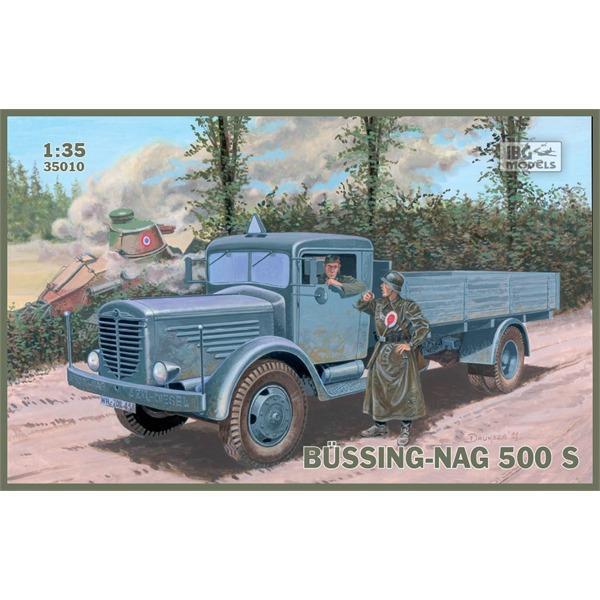
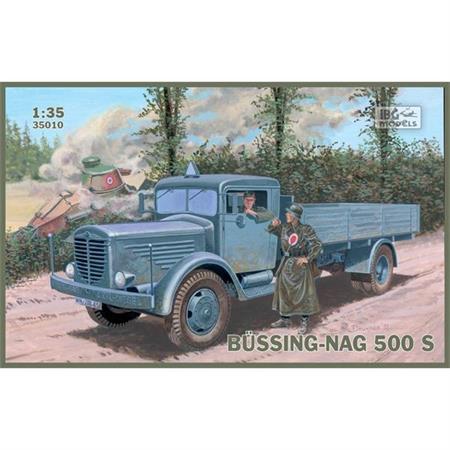
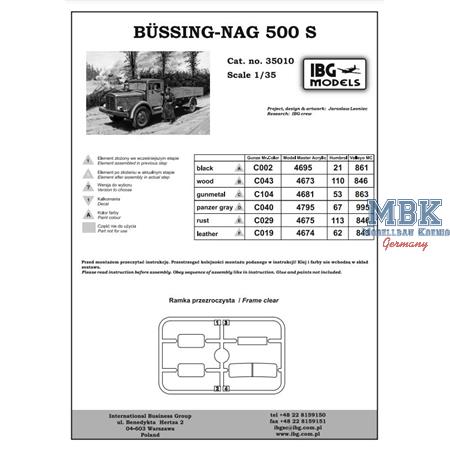
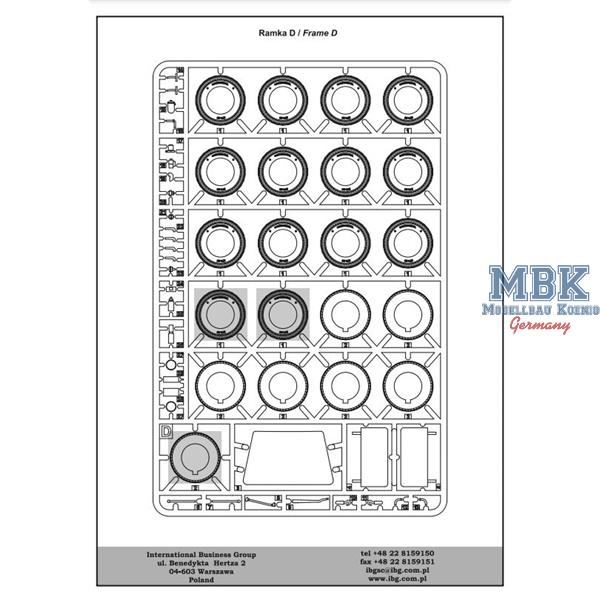
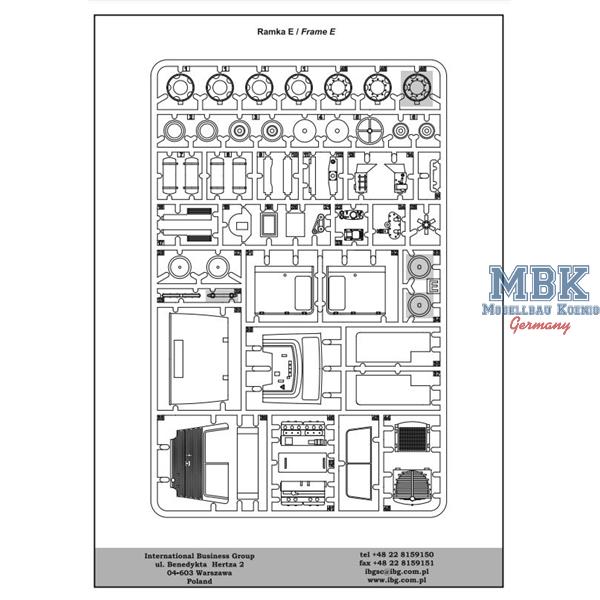
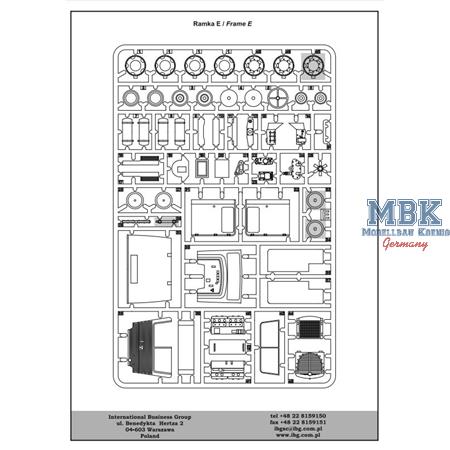
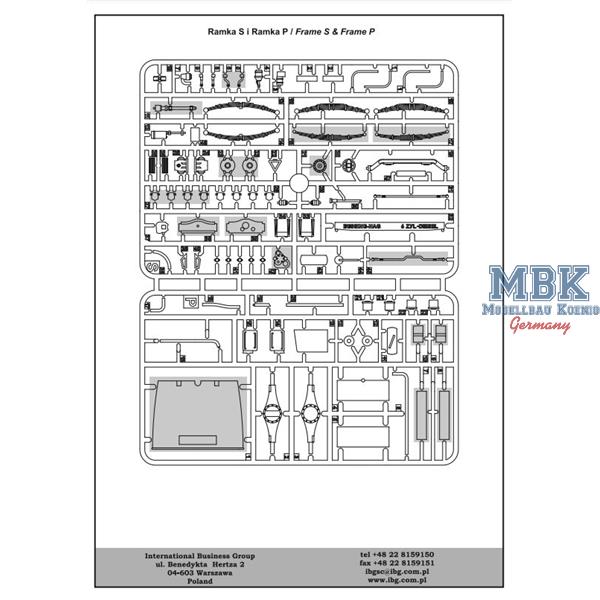
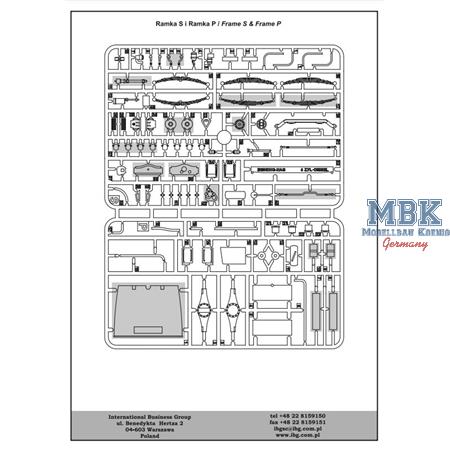
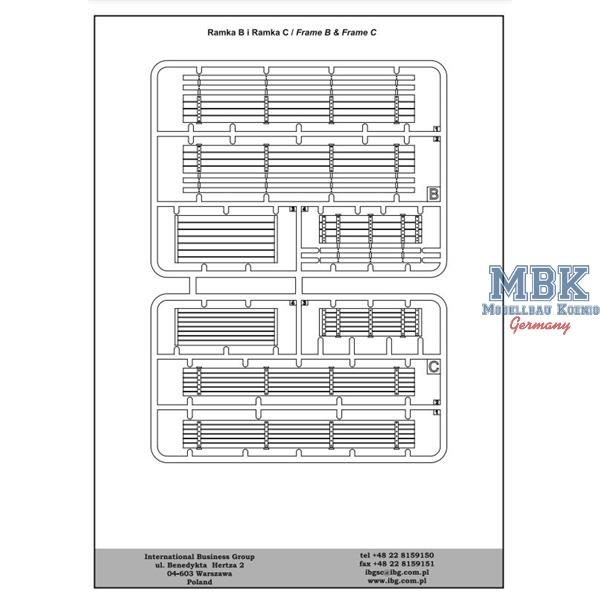
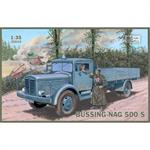
Plastic model kit to build a Büssing-NAG 500S truck
The Büssing-NAG 500 S, 500 A, 4500 S, and 4500 A heavy trucks belong to a common family of German 4.5-ton trucks that were used in large numbers for military transport tasks during World War II. The designations "S" and "A" indicate the drive type: S (road) denotes the two-wheel-drive 4x2 versions, while A (all-wheel drive) designates the off-road 4x4 models.
The 500 S and 500 A series represent the early models, manufactured from around 1940. Both were equipped with a water-cooled, six-cylinder diesel engine producing approximately 105 hp and had a payload capacity of about 4.5 to 4.75 tons. The 500 S was primarily intended for road transport and featured a horizontally sloping hood. The 500 A, on the other hand, featured all-wheel drive, higher ground clearance, and a slightly sloping hood, making it particularly suitable for use on poor roads and off-road terrain. Externally, the early 500 models can often be identified by the seven side vents on the hood.
From 1942 onward, the further developed 4500 S and 4500 A models were introduced, gradually replacing the 500 series. Technically, they remained largely similar to their predecessors and continued to use the proven six-cylinder diesel engine. The most significant change was the modernized body with a redesigned front end and a slightly sloping hood. The 4500 S remained the road-oriented 4x2 version, while the 4500 A was designed as an all-wheel-drive vehicle for difficult terrain. Both variants were produced in numerous configurations, including flatbed trucks, workshop vehicles, tankers, radio trucks, and tractors for special-purpose vehicles.
Three features are particularly helpful for identification in historical photographs: First, a driven front axle with a visible differential indicates an A version, while this feature is absent in the S versions. Second, the 500 S has a nearly horizontal hood, whereas the 500 A and the later 4500 models have a hood line that rises towards the rear. Third, the early and late series differ in the design of the cab and front end, which was more modern and angular on the 4500.
In summary, the 500 S and the 4500 S were the road-oriented standard transport vehicles of their respective generations, while the 500 A and especially the 4500 A represented the off-road, all-wheel-drive versions. The 4500 A became one of the most important heavy trucks of the Wehrmacht during the war years and served as the basis for numerous special-purpose vehicles, workshop trucks, and crane superstructures. For model builders, the differences in the hood, front axle and cab design are particularly important, as these features distinguish the individual variants from each other at first glance.
- 1/35 scale
- engine replica
- Plastic tires with tire label
- 2 marking options
- not built/not painted
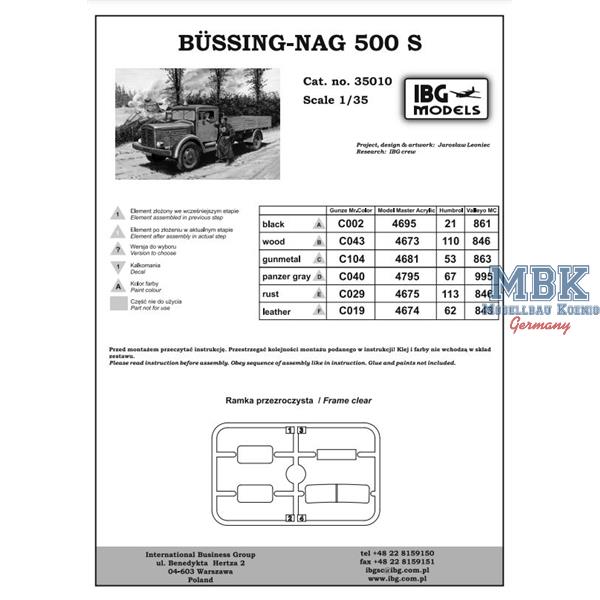
- Paint and glue not included
| You can get more kits from IBG Models Büssing-NAG series here*1: *1 if in stock |
The Büssing-NAG 500 S, 500 A, 4500 S, and 4500 A heavy trucks belong to a common family of German 4.5-ton trucks that were used in large numbers for military transport tasks during World War II. The designations "S" and "A" indicate the drive type: S (road) denotes the two-wheel-drive 4x2 versions, while A (all-wheel drive) designates the off-road 4x4 models.
The 500 S and 500 A series represent the early models, manufactured from around 1940. Both were equipped with a water-cooled, six-cylinder diesel engine producing approximately 105 hp and had a payload capacity of about 4.5 to 4.75 tons. The 500 S was primarily intended for road transport and featured a horizontally sloping hood. The 500 A, on the other hand, featured all-wheel drive, higher ground clearance, and a slightly sloping hood, making it particularly suitable for use on poor roads and off-road terrain. Externally, the early 500 models can often be identified by the seven side vents on the hood.
From 1942 onward, the further developed 4500 S and 4500 A models were introduced, gradually replacing the 500 series. Technically, they remained largely similar to their predecessors and continued to use the proven six-cylinder diesel engine. The most significant change was the modernized body with a redesigned front end and a slightly sloping hood. The 4500 S remained the road-oriented 4x2 version, while the 4500 A was designed as an all-wheel-drive vehicle for difficult terrain. Both variants were produced in numerous configurations, including flatbed trucks, workshop vehicles, tankers, radio trucks, and tractors for special-purpose vehicles.
Three features are particularly helpful for identification in historical photographs: First, a driven front axle with a visible differential indicates an A version, while this feature is absent in the S versions. Second, the 500 S has a nearly horizontal hood, whereas the 500 A and the later 4500 models have a hood line that rises towards the rear. Third, the early and late series differ in the design of the cab and front end, which was more modern and angular on the 4500.
In summary, the 500 S and the 4500 S were the road-oriented standard transport vehicles of their respective generations, while the 500 A and especially the 4500 A represented the off-road, all-wheel-drive versions. The 4500 A became one of the most important heavy trucks of the Wehrmacht during the war years and served as the basis for numerous special-purpose vehicles, workshop trucks, and crane superstructures. For model builders, the differences in the hood, front axle and cab design are particularly important, as these features distinguish the individual variants from each other at first glance.
Customer Reviews 0
Schreiben Sie jetzt Ihre persönliche Erfahrung mit diesem Artikel und helfen Sie anderen bei deren Kaufentscheidung