



V-1 FLYING BOMB Launch Site
Item Number:
TAK2152
TAK2152
Manufacturer
TAKOM MODEL
TAKOM MODEL
Scale:
1:35
1:35
Please login here to see Prices.
More than 5 Pieces available
Shipping 1 - 4 days
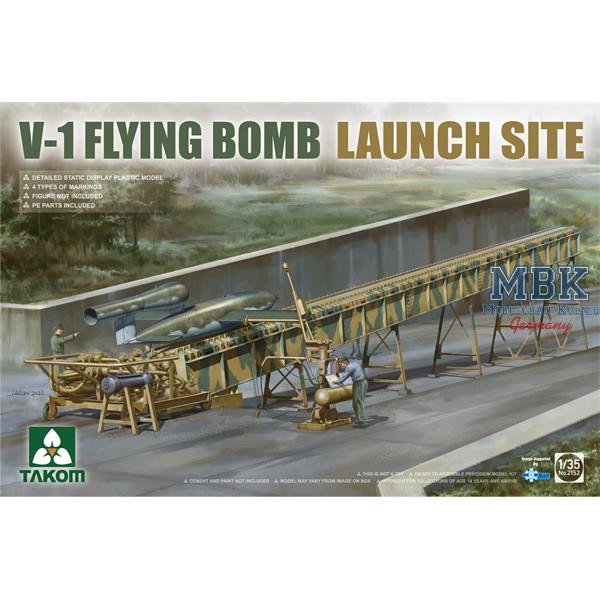
Plastic model kit for a V-1 launch ramp with V-1 (Fieseler Fi 103)
The airframe was originally constructed entirely of welded sheet steel, but when mass production began, plywood was used for the wing construction. The flying bomb was guided to its target by a simple guidance system based on gyroscopes for stabilization, a magnetic compass for course determination, and a barometric altimeter for altitude control. A vane anemometer on the nose powered a counter that determined when the target area was reached and triggered a mechanism that sent the bomb into a dive.
Although many of the early V-1 test flights were launched from German aircraft, the weapon was designed to be launched from ground-based launch sites with ramps equipped with steam or chemical catapults. These sites were quickly built in the Pas-de-Calais region of northern France. While V-1 production was spread across Germany, many were built using forced labor by prisoners at the infamous underground factory "Mittelwerk" near Nordhausen.
During the war, over 30,000 V-1s were produced, of which approximately 10,000 were launched at targets in Great Britain. Of these, only 2,419 reached London, killing 6,184 people and injuring 17,981. Antwerp, a popular target, was hit by 2,448 weapons between October 1944 and March 1945. In total, about 9,000 were launched at targets in continental Europe. Although the V-1s only hit their targets 25% of the time, they proved more economical than the Luftwaffe's bombing campaign of 1940/41. Despite this, the V-1 was primarily a terror weapon and had only a minor overall impact on the outcome of the war.
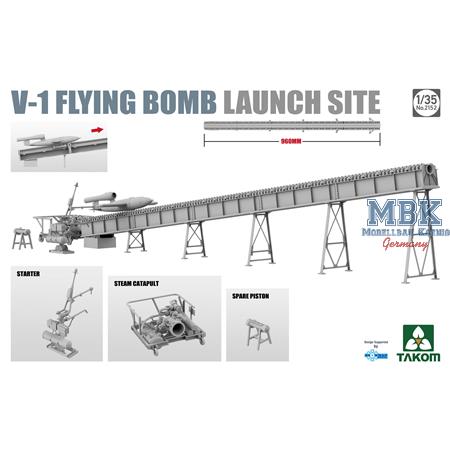
The V-1 launch ramp was built around the Walter WR 2.3 slotted-tube catapult. The ramp's infrastructure was modest—a concrete platform to mount the catapult and support the gas generator cart, along with concrete piles for the catapult's support. The gas generator cart was fueled with a volatile mixture of T-Stoff (hydrogen peroxide) and Z-Stoff (sodium permanganate), which generated a high-pressure gas pulse that forced a piston through the circular tube in the center of the catapult. This piston was attached to a small frame beneath the V-1 rocket's body and accelerated the rocket down the ramp, where its pulsejet engine ignited. The launch was remotely controlled from a nearby bunker via the launching device, which was mounted on the left rear of the rocket's fuselage and contained various electrical connections, safety and activation terminals, and other necessary triggering devices.
Text TAKOM
- Scale 1:35
- Launch ramp length (assembled): 960 mm
- with steam catapult, starter, and spare cylinder
- includes transport trolley
- 4 marking options
- Photo-etched parts included
- Figure not included
- Unassembled, unpainted
- Paint and glue not included
The airframe was originally constructed entirely of welded sheet steel, but when mass production began, plywood was used for the wing construction. The flying bomb was guided to its target by a simple guidance system based on gyroscopes for stabilization, a magnetic compass for course determination, and a barometric altimeter for altitude control. A vane anemometer on the nose powered a counter that determined when the target area was reached and triggered a mechanism that sent the bomb into a dive.
Although many of the early V-1 test flights were launched from German aircraft, the weapon was designed to be launched from ground-based launch sites with ramps equipped with steam or chemical catapults. These sites were quickly built in the Pas-de-Calais region of northern France. While V-1 production was spread across Germany, many were built using forced labor by prisoners at the infamous underground factory "Mittelwerk" near Nordhausen.
During the war, over 30,000 V-1s were produced, of which approximately 10,000 were launched at targets in Great Britain. Of these, only 2,419 reached London, killing 6,184 people and injuring 17,981. Antwerp, a popular target, was hit by 2,448 weapons between October 1944 and March 1945. In total, about 9,000 were launched at targets in continental Europe. Although the V-1s only hit their targets 25% of the time, they proved more economical than the Luftwaffe's bombing campaign of 1940/41. Despite this, the V-1 was primarily a terror weapon and had only a minor overall impact on the outcome of the war.
The V-1 launch ramp was built around the Walter WR 2.3 slotted-tube catapult. The ramp's infrastructure was modest—a concrete platform to mount the catapult and support the gas generator cart, along with concrete piles for the catapult's support. The gas generator cart was fueled with a volatile mixture of T-Stoff (hydrogen peroxide) and Z-Stoff (sodium permanganate), which generated a high-pressure gas pulse that forced a piston through the circular tube in the center of the catapult. This piston was attached to a small frame beneath the V-1 rocket's body and accelerated the rocket down the ramp, where its pulsejet engine ignited. The launch was remotely controlled from a nearby bunker via the launching device, which was mounted on the left rear of the rocket's fuselage and contained various electrical connections, safety and activation terminals, and other necessary triggering devices.
Text TAKOM
Customer Reviews 0

Schreiben Sie jetzt Ihre persönliche Erfahrung mit diesem Artikel und helfen Sie anderen bei deren Kaufentscheidung