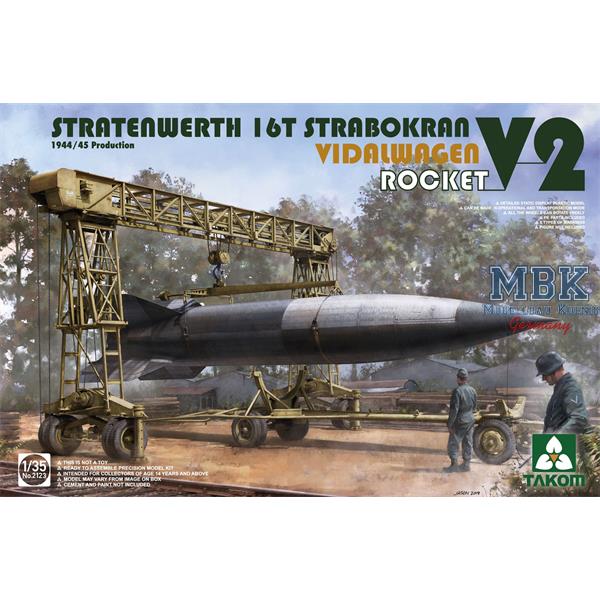
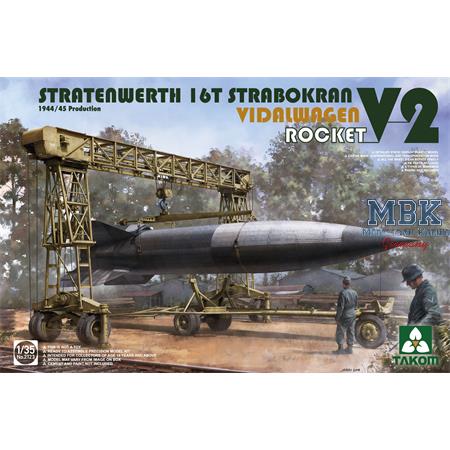

Stratenwerth 16t Strabokran 44/45 + V2 +Vidalwagen
Item Number:
TAK2123
TAK2123
Manufacturer
TAKOM MODEL
TAKOM MODEL
Scale:
1:35
1:35
Please login here to see Prices.
Unfortunately sold out at the moment
No new delivery date known, if necessary please activate stock alert
Plastic model kit for a Stratenwerth 16t Road Gantry Crane (Strabokran), a Vidalwagen (transport trailer), and an A4 (V2) rocket
- 1:35 scale
- Includes 3 models (crane, trailer, rocket)
- The crane can be shown pulled or erected
- Photo-etched parts included
- Markings for 6 versions
- Movable wheels
- Unassembled, unpainted
- Paint and glue not included
| Stratenwerth 16t Road Gantry Crane(Strabokran) | Vidalwagen (transport trailer) | A4 (V2) rocket |
| The Stratenwerth 16-ton road-mobile gantry crane—commonly known as the *Strabokran*—was a portable gantry crane designed for field use and employed by Wehrmacht tank maintenance units during World War II. The system was originally developed by J. S. Fries Sohn in Frankfurt am Main, while the Stratenwerth machine factory in Duisburg manufactured the crane under license. Versions with capacities of 15, 16, and later 20 tons entered service starting around 1942. The 16-ton model became the most widely used variant and was specifically intended for the maintenance of heavy tanks such as the Panther, Tiger I, and Tiger II. The *Strabokran* consisted of two folding gantry supports connected by a horizontal beam. Once assembled, it could lift loads of up to 16 tons—sufficient to remove entire tank turrets, engines, or transmissions. The lifting mechanism utilized cable winches and pulley systems, enabling extensive repair work to be carried out immediately behind the front lines without the need for stationary workshop facilities. For transport, the crane could be dismantled into several trailer units and was typically towed by heavy prime movers such as the Sd.Kfz. 8, the Sd.Kfz. 9 "Famo," or the Hanomag SS 100. Assembly generally required a crew of eight to ten soldiers and could be completed in about an hour under favorable conditions. The *Strabokran* was most significant within the workshop companies of the panzer divisions. There, it facilitated the rapid replacement of damaged engines, running gear, or turrets, eliminating the need to transport vehicles to rear-area maintenance depots. Consequently, many damaged tanks could be restored to operational status close to the front lines. Towards the end of the war, the 16-ton crane also saw service in the V2 (Aggregat 4) rocket program, where it was used alongside the *Vidalwagen* trailer to erect and position the rockets at launch sites. This versatility made it an indispensable tool for German military maintenance and logistics operations. Although relatively few units were built—estimates suggest just over a hundred vehicles or crane sets—the *Strabokran* is considered one of the Wehrmacht's most fascinating pieces of specialized technical equipment. Its well-engineered design combined high lifting capacity with excellent transportability, enabling heavy lifting operations under field conditions that had previously been possible only in stationary workshops. |
The Vidalwagen was a specialized transport and assembly trailer for the German V2 rocket (Aggregat 4) and represented a key stage in the development leading to the later Meillerwagen. Developed from 1942 onwards as part of the A4 rocket program, it was named after the engineer who played a pivotal role in its design. Originally, the Vidalwagen was intended to transport the rocket between production, testing, and launch sites. During the extensive test programs at the Peenemünde Army Research Center, it played a crucial role in the safe handling of the delicate rocket while also serving as the foundation for developing a fully mobile launch system. The two-axle trailer featured a sturdy steel frame with special mounts to carry the V2—which was approximately 14 meters long and weighed around 12.5 tons—in a horizontal position. Unlike the later Meillerwagen, however, the Vidalwagen lacked an integrated erector mechanism. The rocket had to be raised and transferred to the launch table using stationary cranes or a mobile Stratenwerth gantry crane (Strabokran). Consequently, setting up a launch position was significantly more time-consuming and less flexible than with later mobile rocket units. During the V2 testing phase at Peenemünde, the Vidalwagen proved to be a reliable means of transport. However, as the rocket neared operational readiness, it became apparent that frontline deployment required a system capable of transporting, erecting, and transferring the rocket using a single vehicle. This requirement led to the development of the *Meillerwagen*, which largely superseded the *Vidalwagen* from 1944 onwards. Nevertheless, the *Vidalwagen* remained in service with training and testing units, as well as in rear-echelon areas. Although the *Vidalwagen* played a central role in the German rocket program for a relatively short time, it made a significant contribution to the development of mobile V-2 launch technology. The experience gained with it directly informed the design of the *Meillerwagen*, which became one of the most distinctive specialized vehicles used by German rocket units. Today, the *Vidalwagen* ranks among the rarest and least-known vehicles of the A4 program. |
The V-2 rocket (Aggregat 4, or A4) was the world's first operational long-range ballistic missile and is considered a milestone in rocket technology. It was developed under the direction of Wernher von Braun at the Peenemünde Army Research Center. Following successful testing, the Wehrmacht began deploying it for military operations in 1944. Conceived as a long-range "vengeance weapon," the V-2 was designed to strike distant targets without warning. While its development represented a significant technological advancement, it was inextricably linked to the Nazi regime and the exploitation of forced laborers. Much of the mass production took place at the underground Mittelwerk facility near Nordhausen, where thousands of prisoners from the Mittelbau-Dora concentration camp perished under inhumane conditions. The rocket was approximately 14 meters long, had a diameter of 1.65 meters, and a launch weight of around 12.5 tonnes. It was powered by a liquid-propellant rocket engine generating about 25 tonnes of thrust, utilizing liquid oxygen as the oxidizer and a mixture of ethanol and water as the fuel. The burn time was approximately 65 seconds, during which the rocket accelerated to speeds exceeding 5,000 km/h. It then continued its flight along a ballistic trajectory, reaching peak altitudes of roughly 80 to 90 kilometers before striking its target at supersonic speed. Its maximum range was approximately 320 kilometers. The V-2 carried a warhead containing about 975 kilograms of explosive material. For mobile deployment, the rocket was transported using specialized vehicles. After being transported on a *Meillerwagen* (a dedicated trailer), it was erected onto the launch table; subsequently, fuel and liquid oxygen were loaded, and the gyroscopic guidance system was checked. The launch unit also included prime movers such as the Hanomag SS 100, fuel tankers, power generators, telemetry vehicles, and various mobile workshops. This mobile setup allowed a launch site to be established within a few hours and made it significantly more difficult for Allied forces to locate the launch units. Between September 1944 and March 1945, more than 3,000 V-2 rockets were fired at targets in Great Britain, Belgium, France, and the Netherlands. London and Antwerp, in particular, were frequent targets. Their military impact remained limited, however, as accuracy was relatively poor and the high production costs were disproportionate to the strategic value. Nevertheless, the technical significance of the V-2 was immense: much of the knowledge gained during its development contributed to post-war American and Soviet space programs, as well as to the development of modern launch vehicles and ballistic missiles. |
| The *Strabokran* holds particular appeal for historians and scale modelers alike, as it can be authentically integrated into dioramas featuring maintenance scenes, heavy tanks, or V2 transport operations, thereby documenting an often-overlooked yet vital aspect of German military logistics. | Precisely because it served as a link between early experimental transporters and the later mobile launch system, it holds special technical and historical significance for historians and scale modelers alike. |
Customer Reviews 0
Schreiben Sie jetzt Ihre persönliche Erfahrung mit diesem Artikel und helfen Sie anderen bei deren Kaufentscheidung