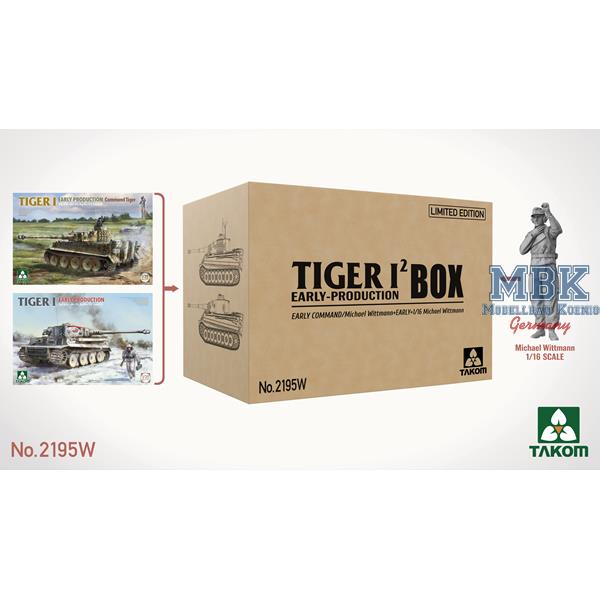
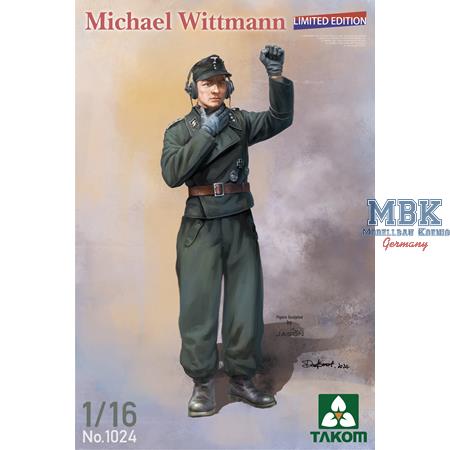


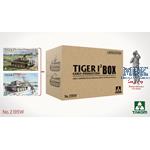
TIGER I² early production Box & 1:16 Wittmann
Item Number:
TAK2195W
TAK2195W
Manufacturer
TAKOM MODEL
TAKOM MODEL
Scale:
1:35
1:35
Please login here to see Prices.
More than 5 Pieces available
Shipping 1 - 4 days
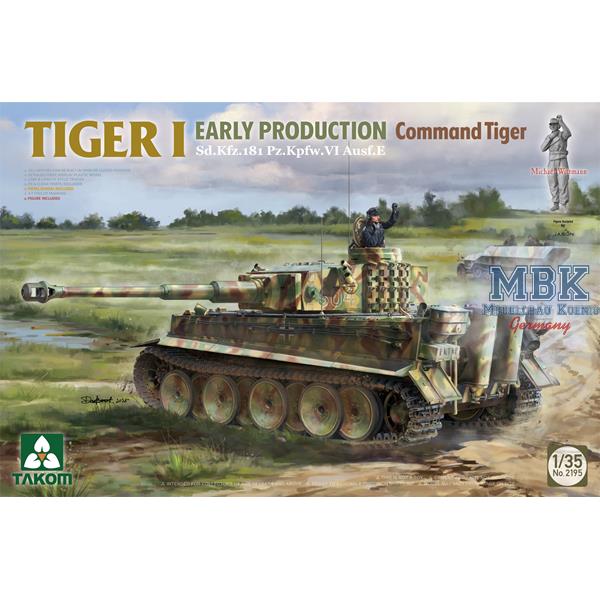
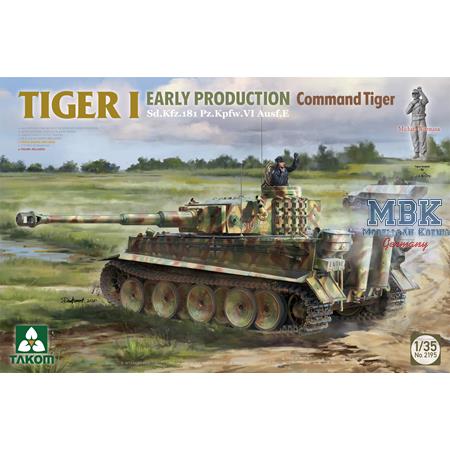
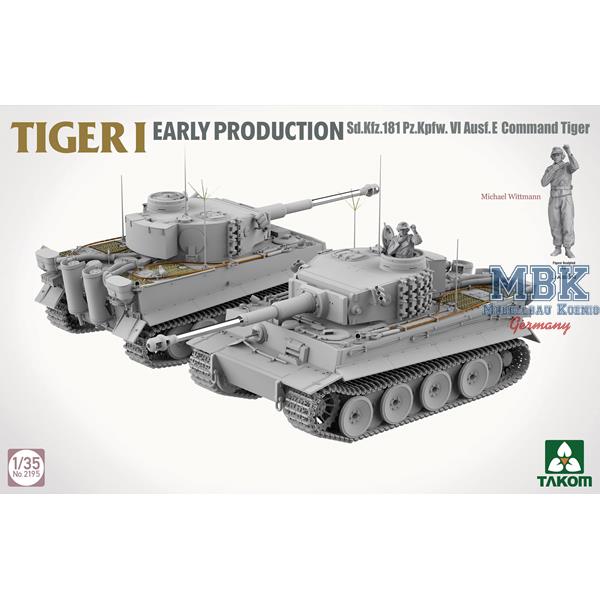
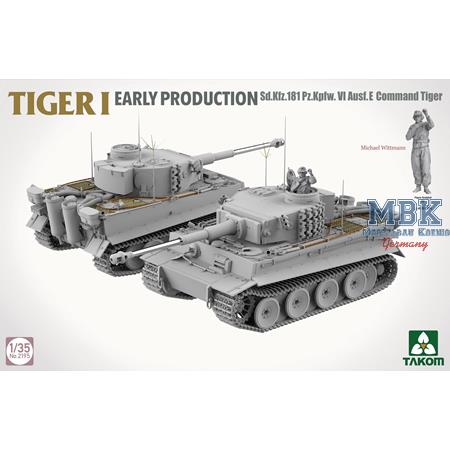
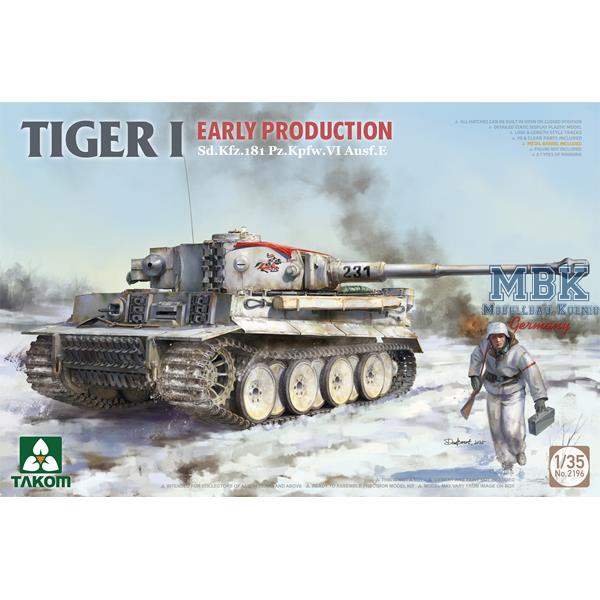
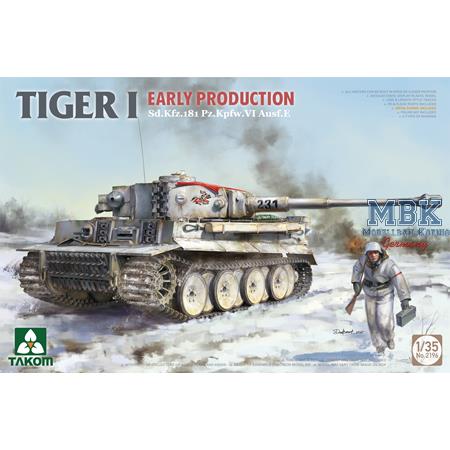
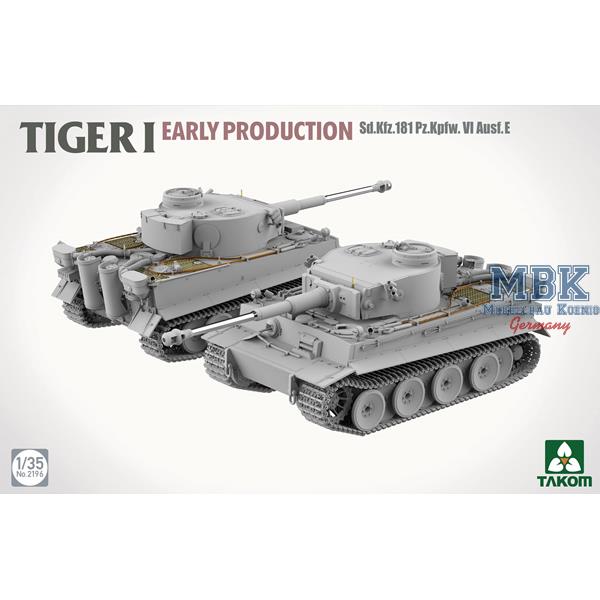
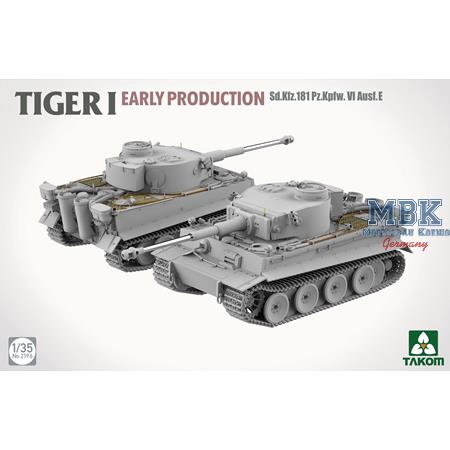
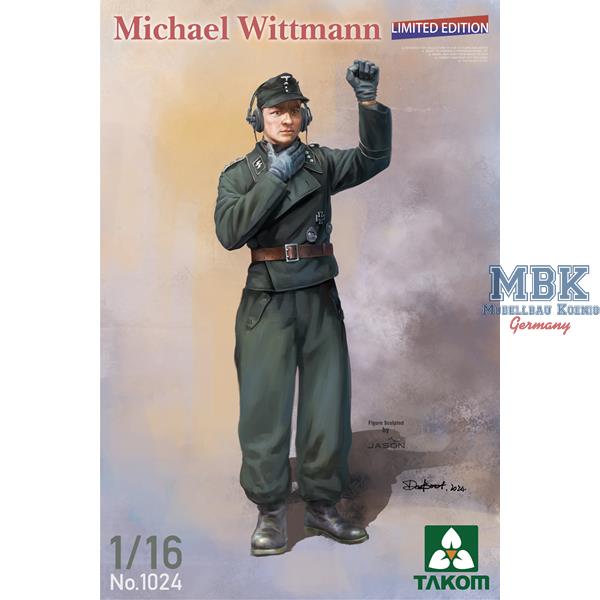
Plastic model kit for building an early Command-Tiger I, an early Tiger I and Michael Wittmann
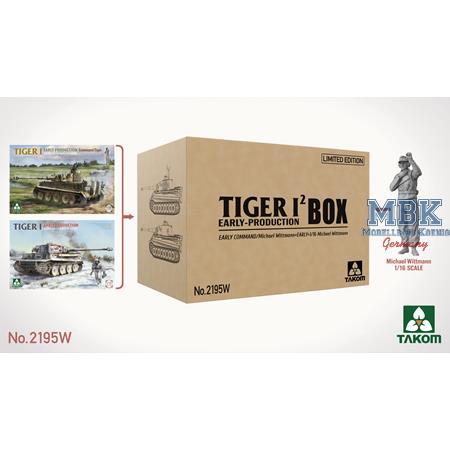
TIGER I2 early production BOX - limited edition
Included are:
TIGER I2 early production BOX - limited edition
Included are:
| 2195 Tiger I early production Sd.Kfz.181 Pz.Kpfw. VI Ausf. E Command Tiger | 2196 Tiger I early production Sd.Kfz.181 Pz.Kpfw. VI Ausf. E | 1024 Michael Wittmann (Limitierte Edition) |
|
|
|
| The Panzerkampfwagen VI Tiger Ausf. E Command Version was a variant of the Tiger I specially equipped for command and control roles. These vehicles were based on the regular early production versions and featured enhanced radio systems to ensure communication between higher commands, armored units, and support units. Externally, they were often identifiable by additional antennas, particularly the distinctive star antenna or loop antenna of certain radios. These vehicles were often recognizable by their additional antennas, especially the distinctive star antenna or loop antenna of certain radios. Like the standard version, the command version was armed with the 8.8 cm KwK 36 L/56 gun and featured the heavy armor of the Tiger I. To make room for additional radio equipment and its operators, some command vehicles had their ammunition carried reduced. Command Tigers were primarily used by company, battalion, and regimental commanders and played a crucial role in commanding heavy tank units on the various fronts of World War II. The early command versions also possessed the typical features of the first production Tigers, including the Feifel air filter system, smoke grenade launchers on the turret, and the early commander's cupola. Due to their central command function, they were considered particularly important vehicles within heavy tank battalions. |
The Panzerkampfwagen VI Tiger Ausf. E, usually referred to simply as the Tiger I, was one of the most famous heavy tanks of World War II. The early production vehicles, manufactured from 1942 onward, were distinguished by several features that differentiated them from later versions. These included the distinctive Feifel air filters at the rear of the vehicle, the smoke grenade launchers on the turret, and early commander's cupolas and tool arrangements. The Tiger I was armed with the powerful 8.8 cm KwK 36 L/56 tank gun, capable of engaging enemy tanks at long range. Its heavy armor made it a formidable opponent on the battlefield. The first Tigers entered service at the end of 1942 and saw action in North Africa, on the Eastern Front, and later in Italy. Despite its high firepower and protective capabilities, the Tiger I was technically complex and required extensive maintenance. However, the early production vehicles served as the foundation for the continuous development of the type, which evolved into one of the most famous German tanks of the war. |
Michael Wittmann was one of the most famous German tank commanders of World War II. He served in the 1st SS Panzer Division Leibstandarte SS Adolf Hitler and gained particular renown as commander of the heavy Panzerkampfwagen VI Tiger Ausf. E. Wittmann participated in numerous engagements on the Eastern Front and later in Normandy with his Tiger I. He achieved international fame especially for his attack near the village of Villers-Bocage on June 13, 1944. There, he managed to disable numerous British tanks and vehicles within a short time and halt an Allied advance. The exact number of vehicles destroyed is given differently in historical literature, but his action is considered one of the most famous tank battles of the war. For his military achievements, Wittmann received several high decorations. On August 8, 1944, he was killed in action during the fighting in Normandy when his Tiger was destroyed by Allied fire. Due to his successes, he was highlighted in propaganda during the war and is still considered one of the most famous tank commanders in military history. |
Customer Reviews 0
Schreiben Sie jetzt Ihre persönliche Erfahrung mit diesem Artikel und helfen Sie anderen bei deren Kaufentscheidung