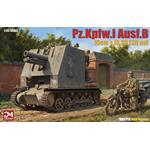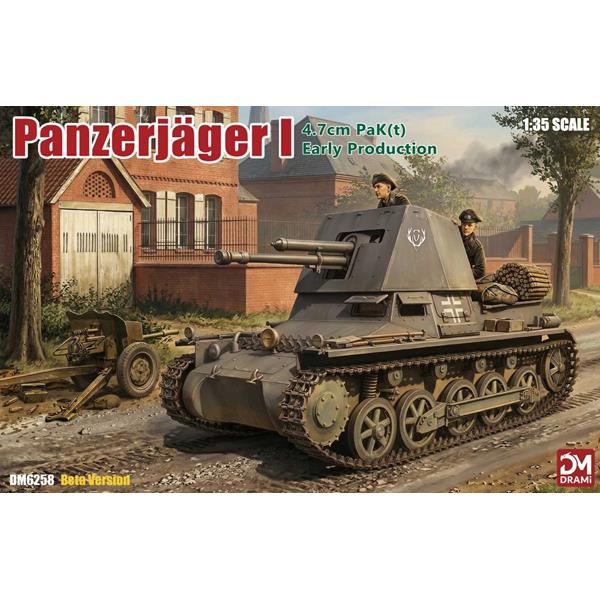
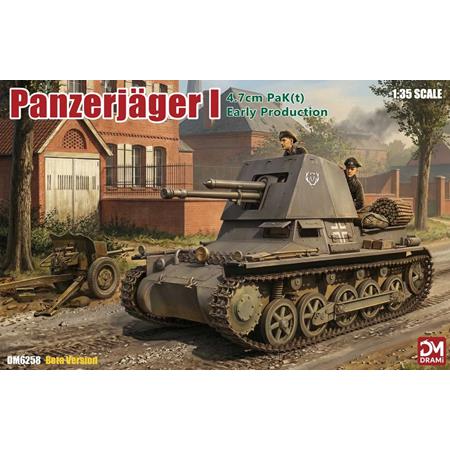


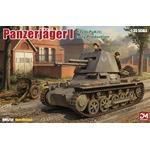
Panzerjäger I 4.7cm PaK(t) Early Production
Item Number:
DRM6258
DRM6258
Manufacturer
DraMi
DraMi
Scale:
1:35
1:35
Please login here to see Prices.
Appears soon
We expect to arrive at early / middle of November 2026
Expected to appear early / middle of November 2026
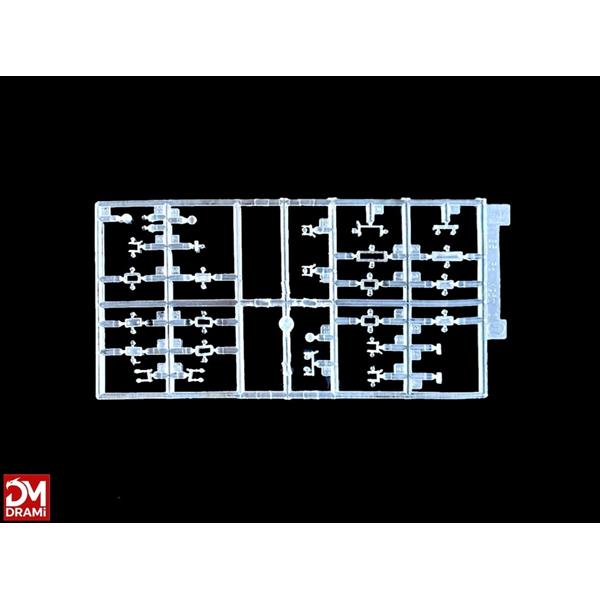
Plastic model kit for building a Panzerjäger I, 4.7 cm PaK(t) (early production)
A total of 202 vehicles were produced between March 1940 and February 1941. The first series was manufactured in 1940.
During the conversion, the rotating machine-gun turret of the Panzer I was removed. The 4.7 cm gun was mounted on a fixed platform above the former fighting compartment; an angled armored shield protected the gun crew from the front and sides. The engine and the basic running gear layout of the Panzer I Ausf. B were retained.
The gun was supplied by Škoda in Czechoslovakia. It offered significantly better anti-tank performance than the original machine-gun armament of the Panzer I. However, the limited traverse meant that the driver had to turn the entire vehicle to engage targets outside the gun's narrow firing arc.
The Panzerjäger I was developed out of a need to provide greater mobility for anti-tank units while repurposing existing Panzer I chassis - which were already considered inadequate as main battle tanks due to their weak armament and thin armor. The German 5 cm PaK (anti-tank gun) initially considered was not yet available in the necessary quantities; the Czech 4.7 cm weapon offered a solution that could be implemented on short notice.
Deployment:
- Scale 1:35
- Fully detailed interior, including the driver's station
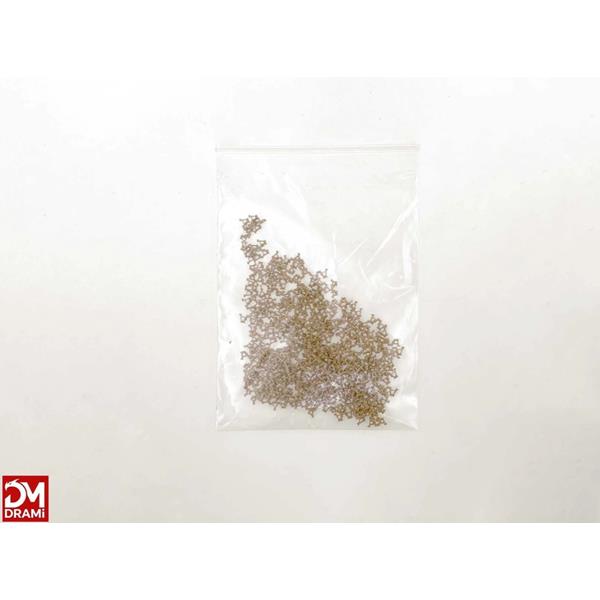
- Individual-link tracks
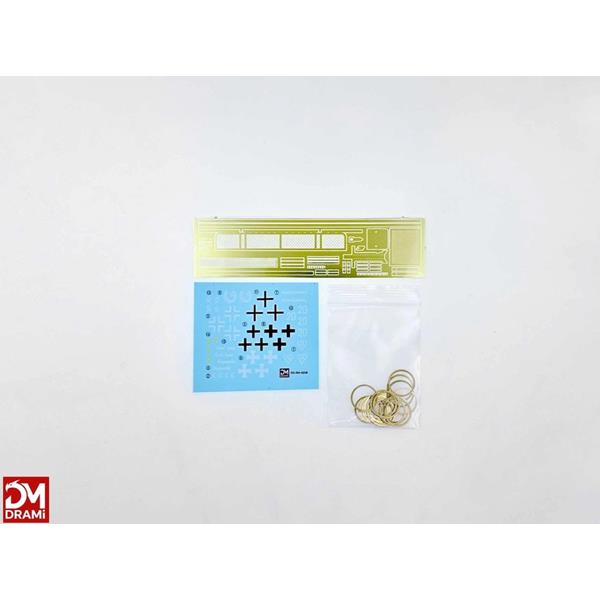
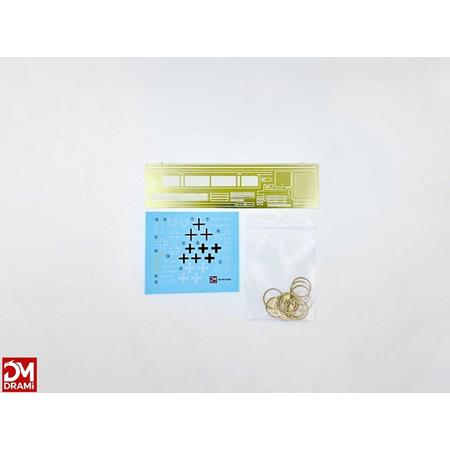
- Includes clear parts and photo-etched parts
- Unbuilt, unpainted
- Paint and glue not included
A total of 202 vehicles were produced between March 1940 and February 1941. The first series was manufactured in 1940.
During the conversion, the rotating machine-gun turret of the Panzer I was removed. The 4.7 cm gun was mounted on a fixed platform above the former fighting compartment; an angled armored shield protected the gun crew from the front and sides. The engine and the basic running gear layout of the Panzer I Ausf. B were retained.
The gun was supplied by Škoda in Czechoslovakia. It offered significantly better anti-tank performance than the original machine-gun armament of the Panzer I. However, the limited traverse meant that the driver had to turn the entire vehicle to engage targets outside the gun's narrow firing arc.
The Panzerjäger I was developed out of a need to provide greater mobility for anti-tank units while repurposing existing Panzer I chassis - which were already considered inadequate as main battle tanks due to their weak armament and thin armor. The German 5 cm PaK (anti-tank gun) initially considered was not yet available in the necessary quantities; the Czech 4.7 cm weapon offered a solution that could be implemented on short notice.
Deployment:
- Western Campaign, 1940: First combat use during the German offensive against France and the Benelux countries.
- North Africa, from 1941: Used by units including *Panzerjäger-Abteilung* 605. The open-topped design and light chassis imposed limitations on the vehicle under the conditions found there.
- Eastern Front, from 1941: Continued use during the invasion of the Soviet Union. Its effectiveness diminished against more heavily armored opponents, while both the crew and the vehicle remained extremely vulnerable.
- By 1942/43: Increasingly replaced by more capable anti-tank vehicles.
Customer Reviews 0
Schreiben Sie jetzt Ihre persönliche Erfahrung mit diesem Artikel und helfen Sie anderen bei deren Kaufentscheidung