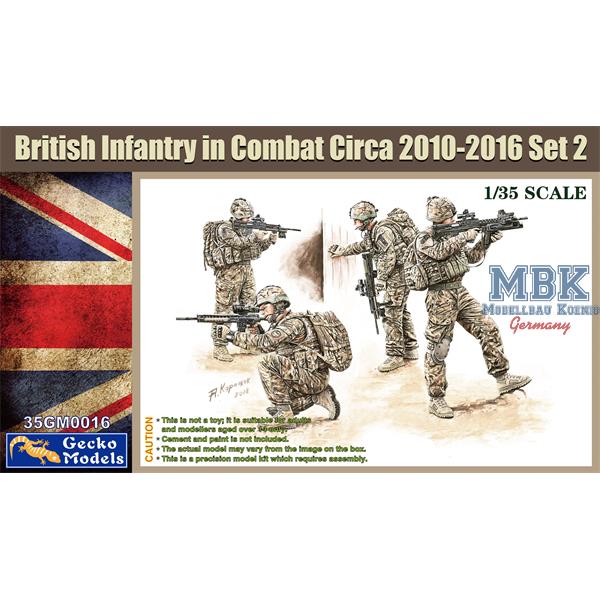
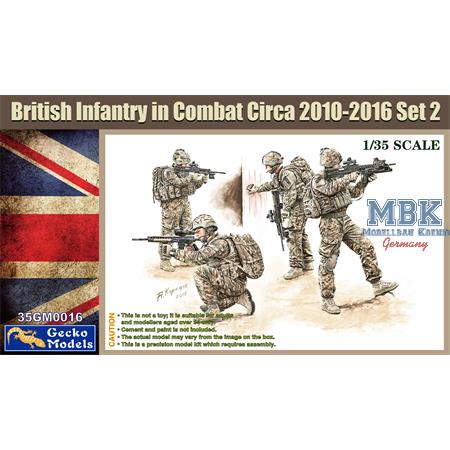

British Infantry in Combat 2010-16 Set 2
Item Number:
35GM0016
35GM0016
Manufacturer
Gecko Models
Gecko Models
Scale:
1:35
1:35
Please login here to see Prices.
Out of Stock
Article is coming
Plastic model kit of British infantry in combat (2010–2016)
One of the most visible changes was the introduction of Multi-Terrain Pattern (MTP) camouflage clothing. It gradually replaced the previously used desert and woodland camouflage patterns and was specifically designed for a wide variety of operational environments. By 2012, MTP had become the standard across the British Armed Forces, defining the infantry's appearance during the final stages of the Afghanistan deployment.
Personal protective equipment during this period primarily included the Mark 4 generation Osprey Body Armour—featuring hard ceramic ballistic plates—and the Mk. 7 combat helmet, which replaced the older Mk. 6A. This gear was complemented by ballistic eyewear, flame-resistant gloves, and modern knee pads. The standard weapon was the L85A2 (SA80), equipped with a SUSAT optical sight or, increasingly, an ACOG or ELCAN sight. Support weapons such as the L7 General Purpose Machine Gun, the L110A2 Light Machine Gun (until its withdrawal from service), the L129A1 Sharpshooter Rifle, and the L16 81mm mortar bolstered the infantry's firepower. The growing threat posed by improvised explosive devices (IEDs) led to a significant shift in operational methods. Patrols were increasingly supported by protected vehicles such as the Mastiff, Foxhound, and Jackal. At the same time, the deployment of unmanned reconnaissance systems and modern communication equipment substantially enhanced the infantry's reconnaissance and command-and-control capabilities.
Following the conclusion of the combat mission in Afghanistan in late 2014, the British infantry shifted its focus to training, international exercises, and maintaining rapid-response readiness within NATO. Lessons learned in Helmand—particularly regarding casualty care, reconnaissance, command procedures, and force protection—had a lasting impact on the British Army’s equipment and tactics, shaping training protocols for years to come.
For scale modelers, this period offers a wide range of authentic display possibilities. Typical subjects include soldiers in MTP uniforms equipped with Osprey body armor, Mk. 7 helmets, and L85A2 rifles with optical sights, alongside extensive personal gear such as radios, Camelbak hydration systems, mine detectors, and rucksacks. When combined with vehicles like the Supacat ATMP, Jackal, Foxhound, or the Boeing CH-47 Chinook, these elements allow for the creation of realistic dioramas that convincingly portray the daily lives of British infantry units in Afghanistan and during the subsequent training phase.
- 1:35 scale
- 4 figures
- Includes accessories and decals
- Unassembled, unpainted
- Paint and glue not included
One of the most visible changes was the introduction of Multi-Terrain Pattern (MTP) camouflage clothing. It gradually replaced the previously used desert and woodland camouflage patterns and was specifically designed for a wide variety of operational environments. By 2012, MTP had become the standard across the British Armed Forces, defining the infantry's appearance during the final stages of the Afghanistan deployment.
Personal protective equipment during this period primarily included the Mark 4 generation Osprey Body Armour—featuring hard ceramic ballistic plates—and the Mk. 7 combat helmet, which replaced the older Mk. 6A. This gear was complemented by ballistic eyewear, flame-resistant gloves, and modern knee pads. The standard weapon was the L85A2 (SA80), equipped with a SUSAT optical sight or, increasingly, an ACOG or ELCAN sight. Support weapons such as the L7 General Purpose Machine Gun, the L110A2 Light Machine Gun (until its withdrawal from service), the L129A1 Sharpshooter Rifle, and the L16 81mm mortar bolstered the infantry's firepower. The growing threat posed by improvised explosive devices (IEDs) led to a significant shift in operational methods. Patrols were increasingly supported by protected vehicles such as the Mastiff, Foxhound, and Jackal. At the same time, the deployment of unmanned reconnaissance systems and modern communication equipment substantially enhanced the infantry's reconnaissance and command-and-control capabilities.
Following the conclusion of the combat mission in Afghanistan in late 2014, the British infantry shifted its focus to training, international exercises, and maintaining rapid-response readiness within NATO. Lessons learned in Helmand—particularly regarding casualty care, reconnaissance, command procedures, and force protection—had a lasting impact on the British Army’s equipment and tactics, shaping training protocols for years to come.
For scale modelers, this period offers a wide range of authentic display possibilities. Typical subjects include soldiers in MTP uniforms equipped with Osprey body armor, Mk. 7 helmets, and L85A2 rifles with optical sights, alongside extensive personal gear such as radios, Camelbak hydration systems, mine detectors, and rucksacks. When combined with vehicles like the Supacat ATMP, Jackal, Foxhound, or the Boeing CH-47 Chinook, these elements allow for the creation of realistic dioramas that convincingly portray the daily lives of British infantry units in Afghanistan and during the subsequent training phase.
Passendes Zubehör

Customer Reviews 0
Schreiben Sie jetzt Ihre persönliche Erfahrung mit diesem Artikel und helfen Sie anderen bei deren Kaufentscheidung