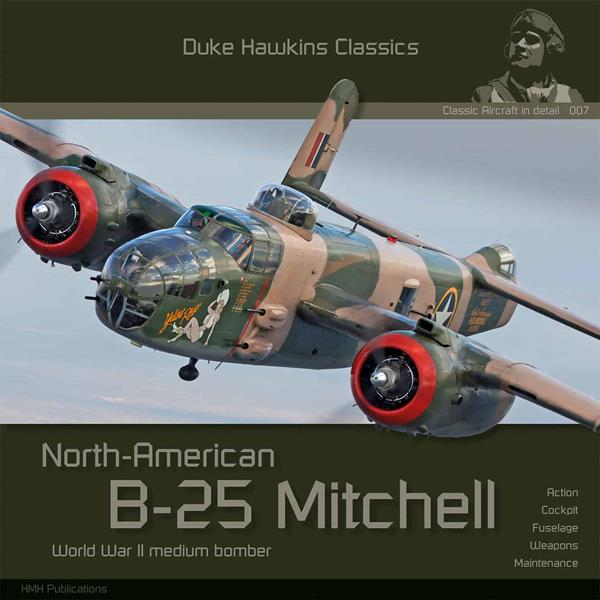
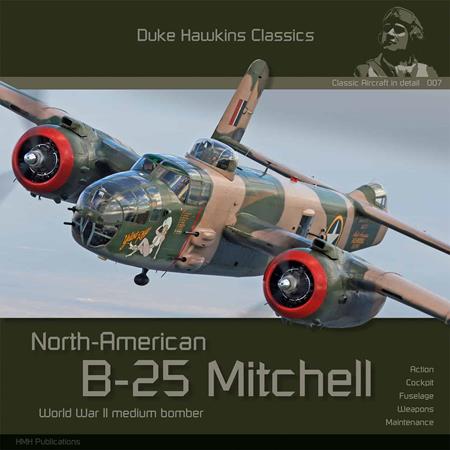

Duke Hawkins: North American B-25 Mitchell
Item Number:
DH-C007
DH-C007
Manufacturer
H.M.H.
H.M.H.
Please login here to see Prices.
Out of Stock
Article is coming
Specialist book on the North American B-25 Mitchell
Development began in the late 1930s in response to a U.S. Army Air Corps requirement for a modern twin-engine bomber. The NA-40 prototype flew in 1939 before North American further developed the design into the B-25. Serial production began in 1941.
The B-25 was an all-metal low-wing monoplane featuring two air-cooled radial engines and retractable tailwheel landing gear. Depending on the variant, it was powered by Wright R-2600 Cyclone engines. The various B-25 versions differed significantly, particularly regarding armament, engines, fuselage configuration, and equipment.
One of the most famous early variants was the B-25B, which gained worldwide renown through the Doolittle Raid on April 18, 1942. A total of 16 specially modified B-25Bs launched from the aircraft carrier USS Hornet for the first American air raid on the Japanese home islands. Modifications for this mission included adjustments to defensive armament and the addition of extra fuel capacity.
Armament
Armament evolved significantly over the course of production. Early B-25s were primarily equipped with 7.62 mm M2 machine guns, whereas later variants were increasingly fitted with 12.7 mm M2 Browning machine guns. This evolution is particularly evident in the B-25H and B-25J models. The B-25H was equipped with exceptionally heavy nose armament, featuring four 12.7 mm machine guns and two 75 mm cannons. This made it especially well-suited for low-level attack and anti-shipping missions.
In contrast, the B-25J was optimized more as a bomber and featured various nose configurations depending on the specific variant. In addition to its internal bomb load, it could carry extra rockets, bombs, or other external stores under its wings.
Operational Use
The Mitchell saw service in almost every major theater of war. In the Pacific, it proved highly versatile, particularly in attacks against Japanese airfields, ships, and ground targets. In Europe, B-25s flew missions that included providing tactical support for Allied ground forces.
The Royal Air Force and other Allied air forces also operated the B-25. Within the RAF, it was designated as the Mitchell Mk.II, Mk.III, and Mk.IV, among others.
A key strength of the B-25 was its adaptability. Beyond conventional bombing runs, it could be deployed for low-level attacks, anti-shipping strikes, reconnaissance, and tactical support missions.
Technical Specifications – B-25J
- In English
- 138 pages
- Dimensions: 240 mm x 240 mm
- High-quality paper
Development began in the late 1930s in response to a U.S. Army Air Corps requirement for a modern twin-engine bomber. The NA-40 prototype flew in 1939 before North American further developed the design into the B-25. Serial production began in 1941.
The B-25 was an all-metal low-wing monoplane featuring two air-cooled radial engines and retractable tailwheel landing gear. Depending on the variant, it was powered by Wright R-2600 Cyclone engines. The various B-25 versions differed significantly, particularly regarding armament, engines, fuselage configuration, and equipment.
One of the most famous early variants was the B-25B, which gained worldwide renown through the Doolittle Raid on April 18, 1942. A total of 16 specially modified B-25Bs launched from the aircraft carrier USS Hornet for the first American air raid on the Japanese home islands. Modifications for this mission included adjustments to defensive armament and the addition of extra fuel capacity.
Armament
Armament evolved significantly over the course of production. Early B-25s were primarily equipped with 7.62 mm M2 machine guns, whereas later variants were increasingly fitted with 12.7 mm M2 Browning machine guns. This evolution is particularly evident in the B-25H and B-25J models. The B-25H was equipped with exceptionally heavy nose armament, featuring four 12.7 mm machine guns and two 75 mm cannons. This made it especially well-suited for low-level attack and anti-shipping missions.
In contrast, the B-25J was optimized more as a bomber and featured various nose configurations depending on the specific variant. In addition to its internal bomb load, it could carry extra rockets, bombs, or other external stores under its wings.
Operational Use
The Mitchell saw service in almost every major theater of war. In the Pacific, it proved highly versatile, particularly in attacks against Japanese airfields, ships, and ground targets. In Europe, B-25s flew missions that included providing tactical support for Allied ground forces.
The Royal Air Force and other Allied air forces also operated the B-25. Within the RAF, it was designated as the Mitchell Mk.II, Mk.III, and Mk.IV, among others.
A key strength of the B-25 was its adaptability. Beyond conventional bombing runs, it could be deployed for low-level attacks, anti-shipping strikes, reconnaissance, and tactical support missions.
Technical Specifications – B-25J
- Crew: Typically 5–6 men, depending on variant and mission
- Powerplant: 2 × Wright R-2600 Cyclone
- Power output: Approx. 1,700 hp per engine
- Top speed: Approx. 440 km/h
- Range: Approx. 2,000 km (depending on payload and version)
- Length: Approx. 16.1 m
- Wingspan: Approx. 20.6 m
- Max. takeoff weight: Approx. 15.9 tonnes
- Bomb load: Typically up to approx. 1,360 kg
- Armament: Multiple 12.7 mm M2 machine guns, depending on version; Later variants additionally carried rockets—or, in the case of the B-25H, two 75 mm cannons.
Customer Reviews 0
Schreiben Sie jetzt Ihre persönliche Erfahrung mit diesem Artikel und helfen Sie anderen bei deren Kaufentscheidung