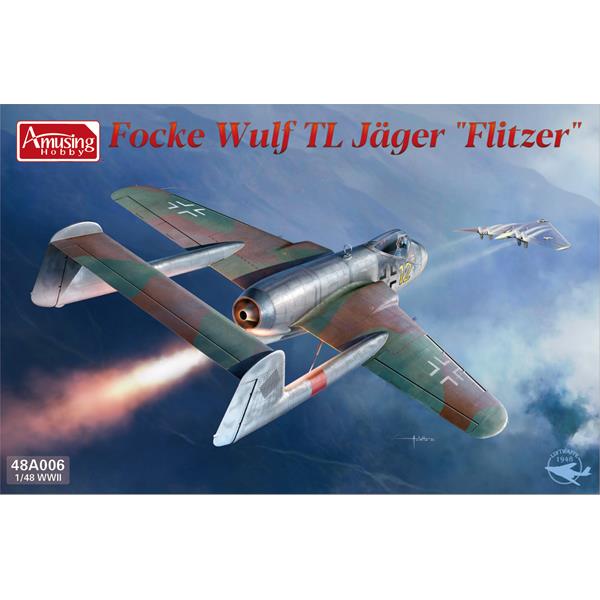
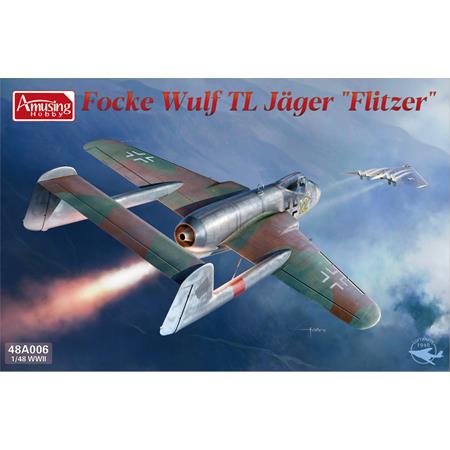

Focke Wulf TL Jäger "Flitzer"
Item Number:
AH48A006
AH48A006
Manufacturer
AMUSING HOBBY
AMUSING HOBBY
Scale:
1:48
1:48

Please login here to see Prices.
Sonderangebot
Appears soon
We expect to arrive at middle / end of December 2026
Expected to appear middle / end of December 2026
Plastic model kit of a Focke Wulf TL-Jäger "Flitzer"
Scale 1:48
unbuilt / unpainted
Paint and glue not included
pre-order price valid until 25th September 2026
The Focke-Wulf TL-Jäger "Flitzer" (internally designated as Projekt VI, Entwurf 281, or P.0310025) was an ambitious German jet fighter project developed toward the end of World War II under the leadership of chief designer Kurt Tank. The project aimed to create a state-of-the-art, single-seat jet interceptor, but it never advanced beyond wind tunnel testing and a full-scale wooden mock-up.
The most distinctive structural feature of the "Flitzer" was its twin-boom (Doppelleitwerksträger) layout. The planned turbojet engine—primarily the Heinkel HeS 011—was to be housed centrally in the lower section of the short fuselage. To allow the hot exhaust gases to discharge freely to the rear, engineers mounted the tail unit on two separate booms extending from the swept wings—a design configuration that gained fame after the war in British aircraft such as the De Havilland Vampire. Later revisions also incorporated a supplementary Walter rocket engine. This hybrid propulsion system was intended to give the interceptor an enormous burst of thrust and superior climb rates when engaging enemy bomber formations.
With a projected wingspan of approximately 8.00 meters and an overall length of 10.55 meters, the fighter was expected to reach top speeds of up to 980 km/h. Its intended armament consisted of a heavy combination of two 30 mm MK 108 cannons and two 20 mm MG 151/20 cannons mounted in the nose.
Although development progressed rapidly starting in 1943, the project came to a final halt in February 1945. The Luftwaffe High Command canceled the endeavor under the Emergency Fighter Program (Jäger-Notprogramm) to consolidate remaining resources on production-ready models like the Messerschmitt Me 262 or more advanced concepts like Focke-Wulf's own Ta 183 "Huckebein." Consequently, a flyable prototype of the "Flitzer" was never completed.
Scale 1:48
unbuilt / unpainted
Paint and glue not included
pre-order price valid until 25th September 2026
The Focke-Wulf TL-Jäger "Flitzer" (internally designated as Projekt VI, Entwurf 281, or P.0310025) was an ambitious German jet fighter project developed toward the end of World War II under the leadership of chief designer Kurt Tank. The project aimed to create a state-of-the-art, single-seat jet interceptor, but it never advanced beyond wind tunnel testing and a full-scale wooden mock-up.
The most distinctive structural feature of the "Flitzer" was its twin-boom (Doppelleitwerksträger) layout. The planned turbojet engine—primarily the Heinkel HeS 011—was to be housed centrally in the lower section of the short fuselage. To allow the hot exhaust gases to discharge freely to the rear, engineers mounted the tail unit on two separate booms extending from the swept wings—a design configuration that gained fame after the war in British aircraft such as the De Havilland Vampire. Later revisions also incorporated a supplementary Walter rocket engine. This hybrid propulsion system was intended to give the interceptor an enormous burst of thrust and superior climb rates when engaging enemy bomber formations.
With a projected wingspan of approximately 8.00 meters and an overall length of 10.55 meters, the fighter was expected to reach top speeds of up to 980 km/h. Its intended armament consisted of a heavy combination of two 30 mm MK 108 cannons and two 20 mm MG 151/20 cannons mounted in the nose.
Although development progressed rapidly starting in 1943, the project came to a final halt in February 1945. The Luftwaffe High Command canceled the endeavor under the Emergency Fighter Program (Jäger-Notprogramm) to consolidate remaining resources on production-ready models like the Messerschmitt Me 262 or more advanced concepts like Focke-Wulf's own Ta 183 "Huckebein." Consequently, a flyable prototype of the "Flitzer" was never completed.
Customer Reviews 0
Schreiben Sie jetzt Ihre persönliche Erfahrung mit diesem Artikel und helfen Sie anderen bei deren Kaufentscheidung