

WWII British Army Open Cab 30-cwt 4x2 GS Truck
Item Number:
35GM0071
35GM0071
Manufacturer
Gecko Models
Gecko Models
Scale:
1:35
1:35
Please login here to see Prices.
3 Pieces available
Shipping 1 - 4 days
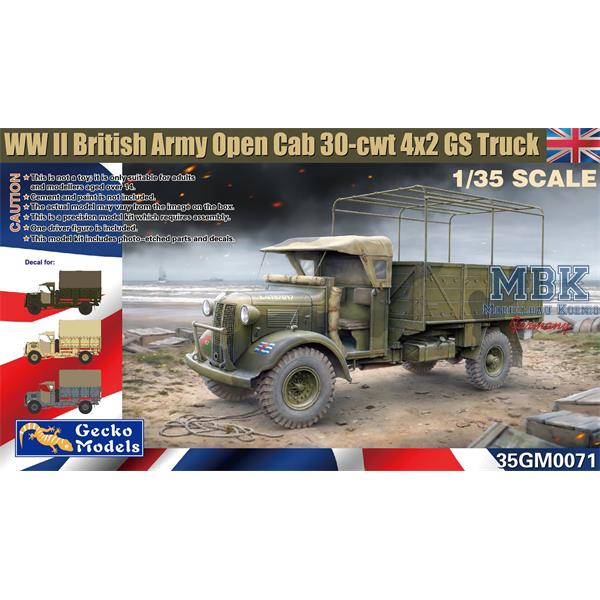
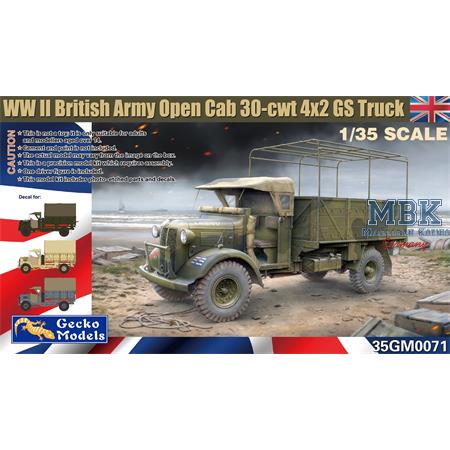
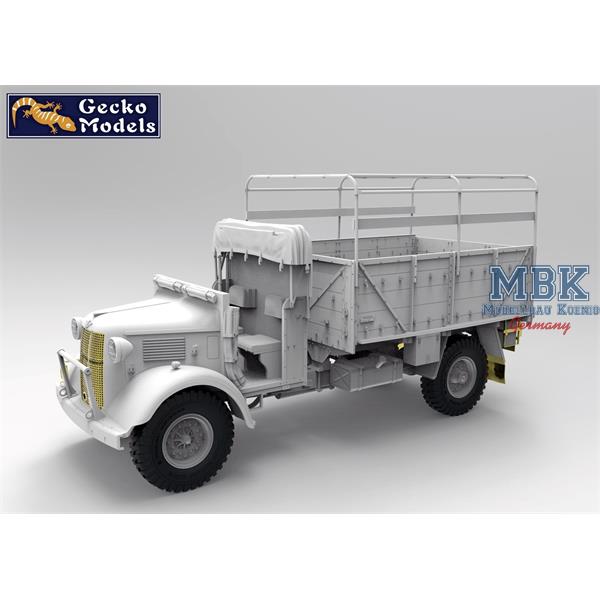
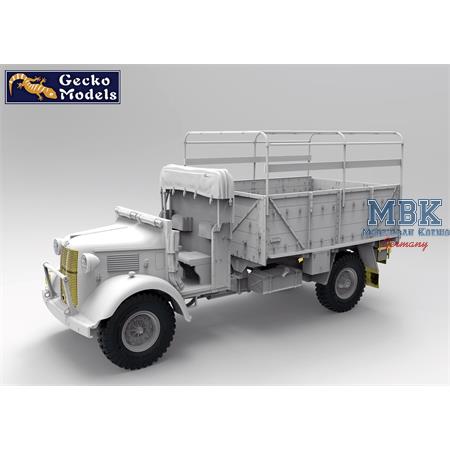
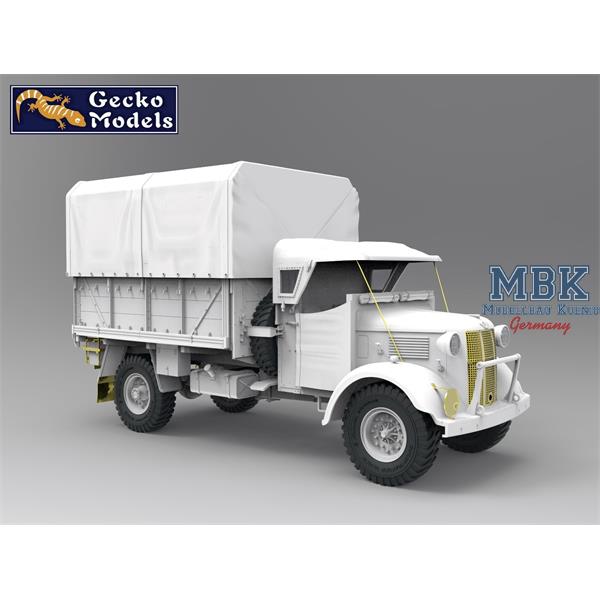
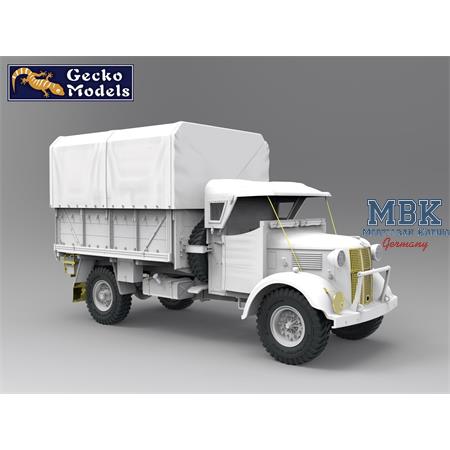
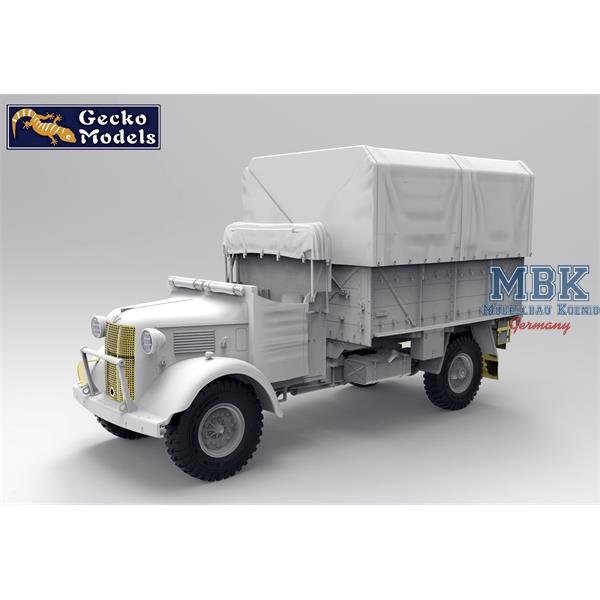
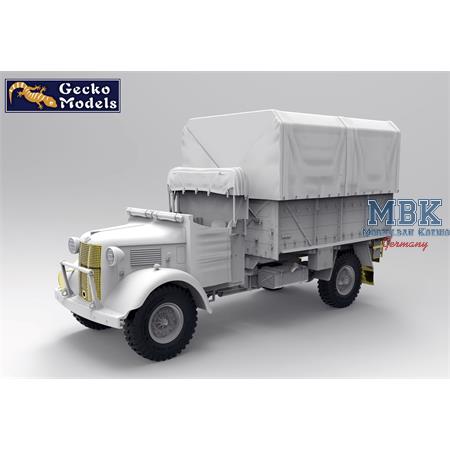
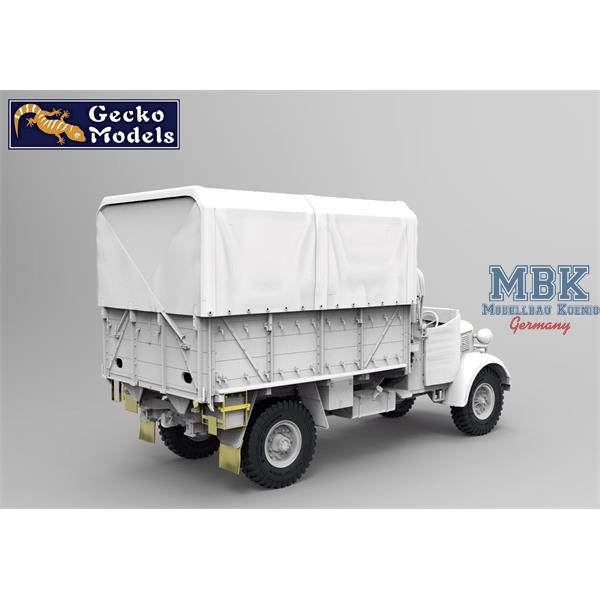
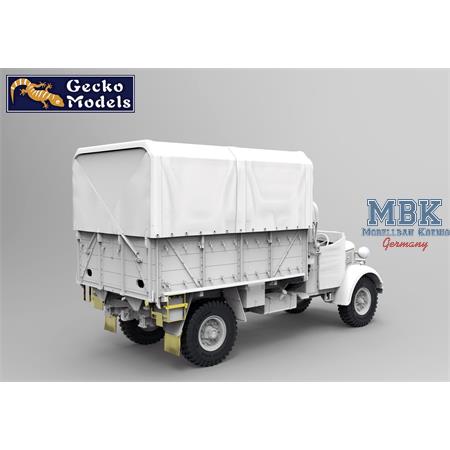
Plastic kit of a WWII British Army Open Cab 30-cwt 4x2 GS Truck
The early version with an open cab (factory designation YC) featured a simple driver's compartment without fixed doors. The driver and passenger were protected only by a lightweight canvas cover that could be stretched over a tubular frame. This design accelerated production and saved materials but offered little protection against the elements or enemy fire. Many of these vehicles saw service during the 1940 Western Campaign, particularly during the Dunkirk evacuation. A large number of the open-cab K30s were lost there along with the equipment abandoned by the British Expeditionary Force.
Technically, the Austin K30 was a conventional 4×2 truck with a front-mounted engine. It was powered by a water-cooled, six-cylinder overhead-valve (OHV) petrol engine producing approximately 60 hp. Power was transmitted to the rear axle via a four-speed gearbox. Leaf springs on both axles and hydraulic brakes ensured robust handling characteristics suitable for roads and light off-road terrain. Due to its relatively low weight, the K30 was more economical than the larger K2 and K3 models and was particularly well-suited for general transport tasks within British supply units.
From 1941 onwards, the open-cab YC version was replaced by vehicles featuring an enclosed all-steel cab (GS). This version largely adopted the cab from Austin’s civilian trucks, offering the crew significantly better protection against the elements and shrapnel. Consequently, the open-cab variant was phased out after a relatively short production run, making original examples extremely rare today. As far as is currently known, very few Austin K30s have survived at all, with only a handful of restored vehicles among them.
The open-cab (YC) version is of particular interest to scale modelers, as it reflects the improvised nature of the early war years. Typical features include the absence of solid doors, a simple canvas-cover frame over the driver and passenger, an exposed interior, and a basic cargo bed with drop-down sides. Vehicles of this type were predominantly painted in early-war camouflage schemes - Khaki Green No. 3 with a contrasting Dark Green No. 4 pattern - and are ideal for dioramas set in 1939-40, particularly those depicting the British Expeditionary Force in France or the retreat to Dunkirk.
- 1:35 scale
- Highly detailed chassis and engine replica
- Comprehensive interior detail
- Entrances can be built open or closed
- Open or closed roof option
- Cargo bed can be built with hoops or canvas cover
- Poseable front wheels
- Notek light included for the German version
- Photo-etched parts and decals included
- 1 driver figure
- Personal equipment (helmets, bags, blankets, etc.) included
- 3 marking options
- L4157017: II Corps, 33rd Section, 2nd Personnel Company, Royal Army Service Corps, Dunkirk, May 1940
- L4157623: 1st Btn., Royal Fusiliers, 5th Indian Infantry Brigade, 4th Indian Infantry Division, Western Desert Force, August 1941
- WH-425685: K30 captured vehicle (Beutewagen), Wehrmacht Heer, Operation Barbarossa, USSR, August 1941
- unbuilt, unpainted
- Paint and glue not included
The early version with an open cab (factory designation YC) featured a simple driver's compartment without fixed doors. The driver and passenger were protected only by a lightweight canvas cover that could be stretched over a tubular frame. This design accelerated production and saved materials but offered little protection against the elements or enemy fire. Many of these vehicles saw service during the 1940 Western Campaign, particularly during the Dunkirk evacuation. A large number of the open-cab K30s were lost there along with the equipment abandoned by the British Expeditionary Force.
Technically, the Austin K30 was a conventional 4×2 truck with a front-mounted engine. It was powered by a water-cooled, six-cylinder overhead-valve (OHV) petrol engine producing approximately 60 hp. Power was transmitted to the rear axle via a four-speed gearbox. Leaf springs on both axles and hydraulic brakes ensured robust handling characteristics suitable for roads and light off-road terrain. Due to its relatively low weight, the K30 was more economical than the larger K2 and K3 models and was particularly well-suited for general transport tasks within British supply units.
From 1941 onwards, the open-cab YC version was replaced by vehicles featuring an enclosed all-steel cab (GS). This version largely adopted the cab from Austin’s civilian trucks, offering the crew significantly better protection against the elements and shrapnel. Consequently, the open-cab variant was phased out after a relatively short production run, making original examples extremely rare today. As far as is currently known, very few Austin K30s have survived at all, with only a handful of restored vehicles among them.
The open-cab (YC) version is of particular interest to scale modelers, as it reflects the improvised nature of the early war years. Typical features include the absence of solid doors, a simple canvas-cover frame over the driver and passenger, an exposed interior, and a basic cargo bed with drop-down sides. Vehicles of this type were predominantly painted in early-war camouflage schemes - Khaki Green No. 3 with a contrasting Dark Green No. 4 pattern - and are ideal for dioramas set in 1939-40, particularly those depicting the British Expeditionary Force in France or the retreat to Dunkirk.
Passendes Zubehör

Customer Reviews 0
Schreiben Sie jetzt Ihre persönliche Erfahrung mit diesem Artikel und helfen Sie anderen bei deren Kaufentscheidung