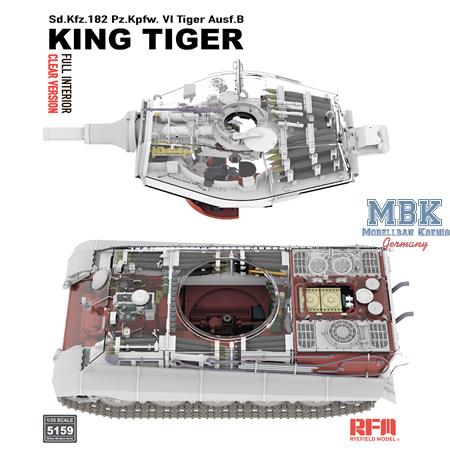


Tiger Ausf.B "King Tiger" Clear Version, INTERIOR
Item Number:
RFM5159
RFM5159
Manufacturer
RYE FIELD MODEL
RYE FIELD MODEL
Scale:
1:35
1:35
Please login here to see Prices.
More than 5 Pieces available
Shipping 1 - 4 days
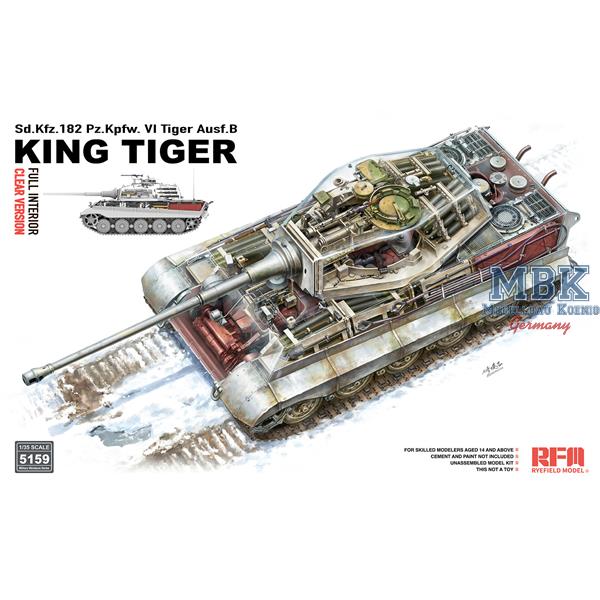
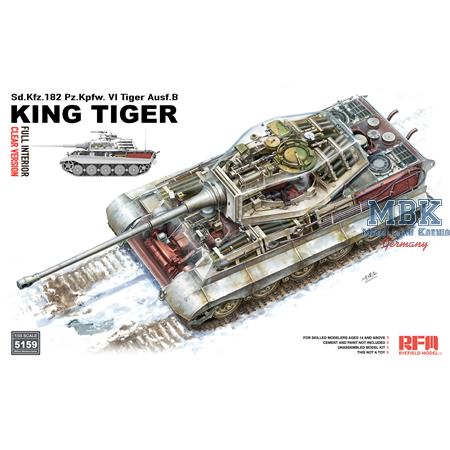
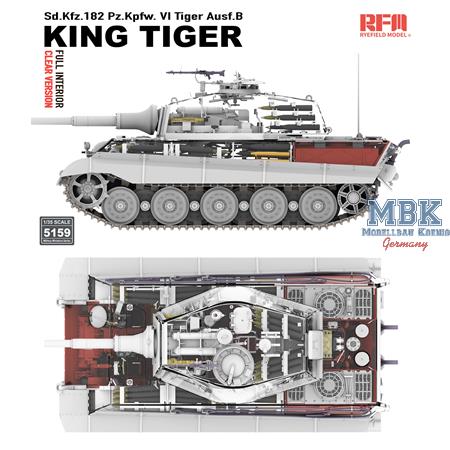
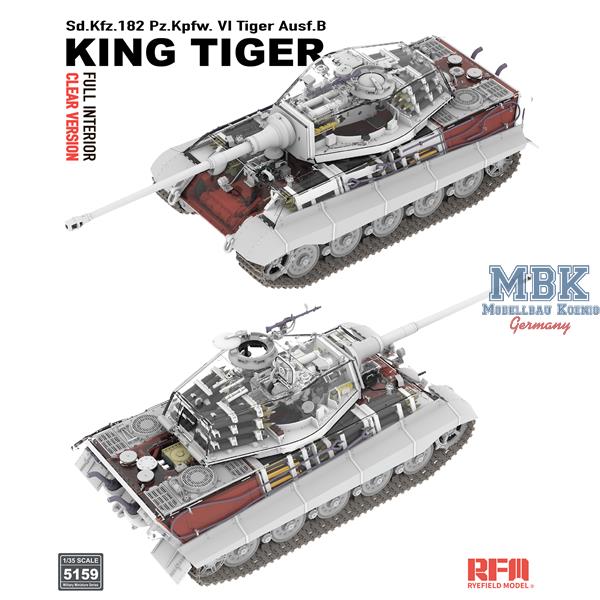
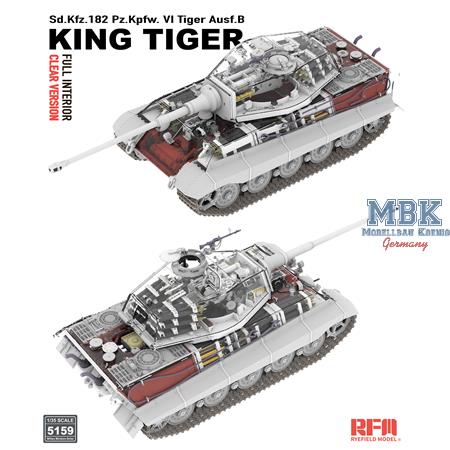
Plastic model kit for building an Sd.Kfz. 182 Pz.Kpfw. VI Tiger Ausf. B King Tiger
Full interior
Externally, the Henschel turret differed significantly from the early Porsche turret. Its turret front was much flatter and more heavily sloped, largely eliminating the problematic shot-trap effect associated with the Porsche turret. At the same time, the new shape provided a more practical interior layout and improved crew positioning. The turret front featured armor approximately 180 mm thick, while the sides and roof had armor thicknesses of about 80 mm and 40 mm, respectively. Another characteristic feature was the larger, lower-profile commander's cupola, which offered improved all-round visibility.
Its main armament was the outstanding 8.8 cm KwK 43 L/71, one of the most powerful tank guns of World War II, capable of engaging enemy tanks at long ranges. Additionally, the King Tiger was equipped with a coaxial 7.92 mm MG 34 and a second MG 34 mounted in the hull front. The crew consisted of five men: commander, gunner, loader, radio operator, and driver.
A key feature of the Henschel turret was its redesigned gun mantlet. With the early Porsche turret, there was a risk that projectiles ricocheting off the lower, curved turret face would be deflected onto the hull roof. The flatter design of the Henschel turret eliminated this structural drawback, making it the characteristic standard configuration for the King Tiger.
Overall, the King Tiger with the Henschel turret combined exceptionally powerful armament and superior armor protection with—admittedly—enormous weight and the resulting high mechanical strain. From mid-1944 onwards, the vehicles increasingly reached the front lines and were deployed with units such as heavy tank battalions. Despite its impressive combat capability, the King Tiger suffered from high fuel consumption, limited operational range, and significant maintenance requirements.
Full interior
- Scale 1:35
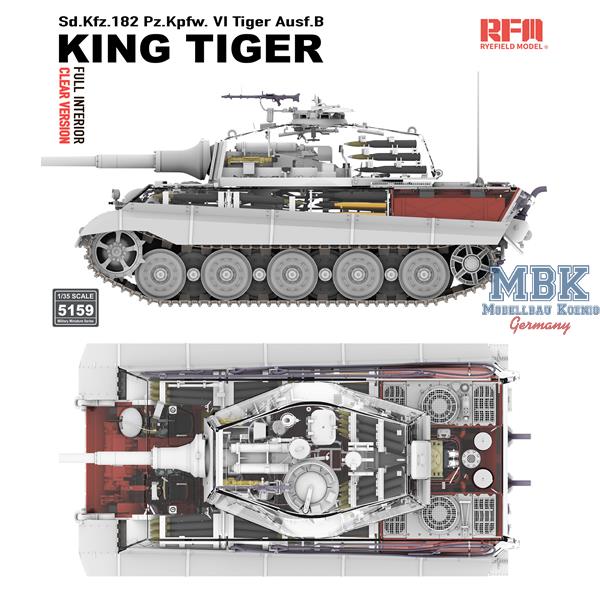
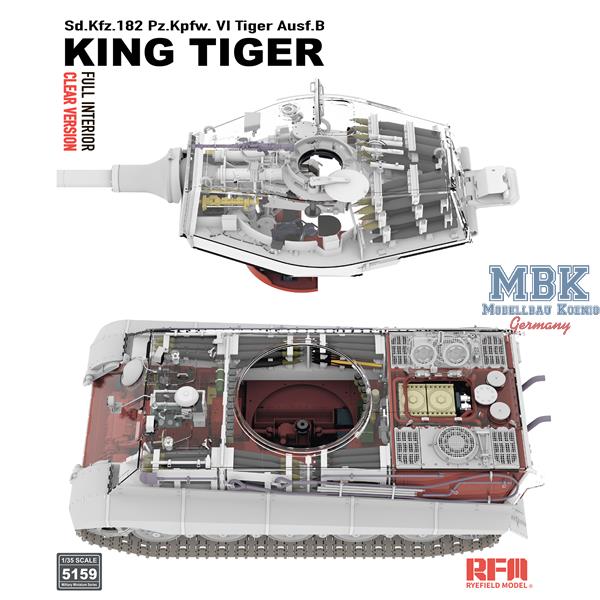
- Complete interior (driver's compartment, combat compartment, engine compartment)
- with clear parts for turret and hull to display the interior
- Clear and photo-etched parts included
- Workable torsion bars
- Workable single-link tracks
- Hatches can be built open or closed
- Workable cannon with breech details
- Unbuilt/unpainted
- Paint and glue not included
Externally, the Henschel turret differed significantly from the early Porsche turret. Its turret front was much flatter and more heavily sloped, largely eliminating the problematic shot-trap effect associated with the Porsche turret. At the same time, the new shape provided a more practical interior layout and improved crew positioning. The turret front featured armor approximately 180 mm thick, while the sides and roof had armor thicknesses of about 80 mm and 40 mm, respectively. Another characteristic feature was the larger, lower-profile commander's cupola, which offered improved all-round visibility.
Its main armament was the outstanding 8.8 cm KwK 43 L/71, one of the most powerful tank guns of World War II, capable of engaging enemy tanks at long ranges. Additionally, the King Tiger was equipped with a coaxial 7.92 mm MG 34 and a second MG 34 mounted in the hull front. The crew consisted of five men: commander, gunner, loader, radio operator, and driver.
A key feature of the Henschel turret was its redesigned gun mantlet. With the early Porsche turret, there was a risk that projectiles ricocheting off the lower, curved turret face would be deflected onto the hull roof. The flatter design of the Henschel turret eliminated this structural drawback, making it the characteristic standard configuration for the King Tiger.
Overall, the King Tiger with the Henschel turret combined exceptionally powerful armament and superior armor protection with—admittedly—enormous weight and the resulting high mechanical strain. From mid-1944 onwards, the vehicles increasingly reached the front lines and were deployed with units such as heavy tank battalions. Despite its impressive combat capability, the King Tiger suffered from high fuel consumption, limited operational range, and significant maintenance requirements.


Customer Reviews 0
Schreiben Sie jetzt Ihre persönliche Erfahrung mit diesem Artikel und helfen Sie anderen bei deren Kaufentscheidung