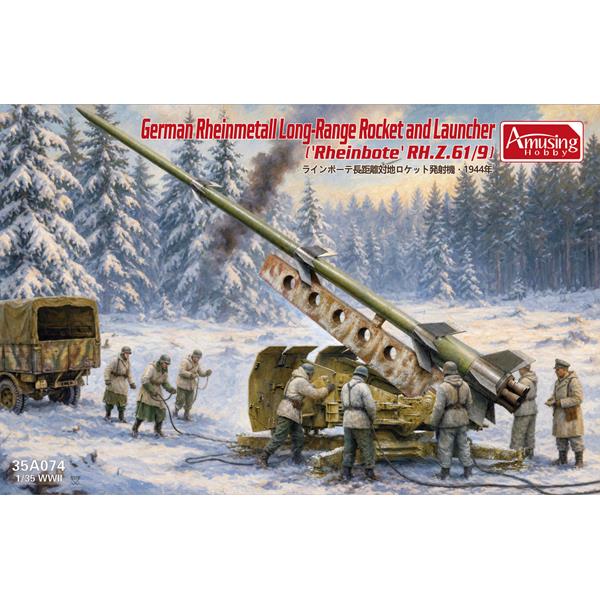
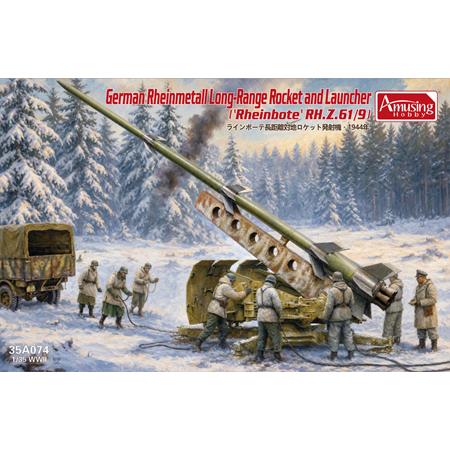
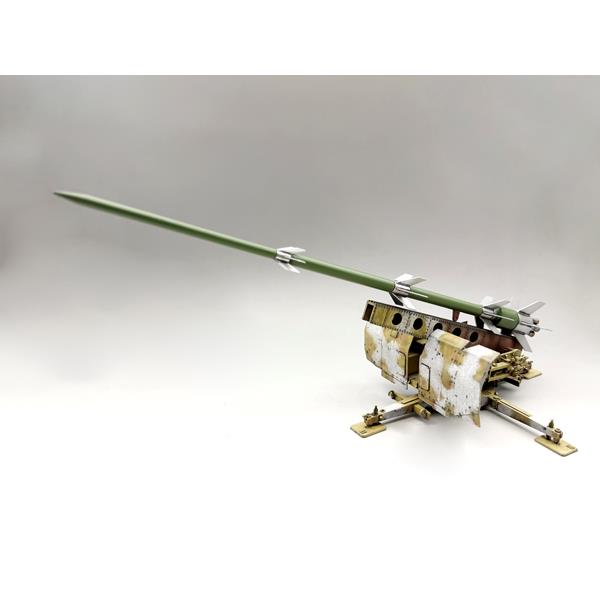
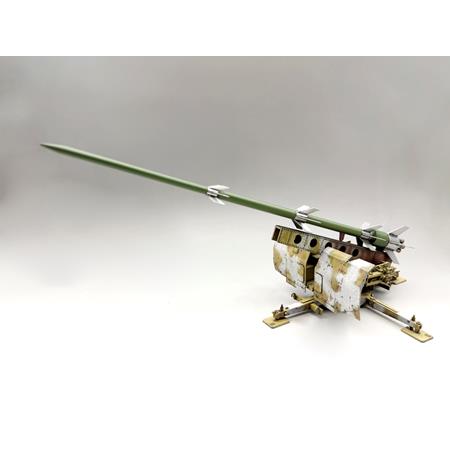
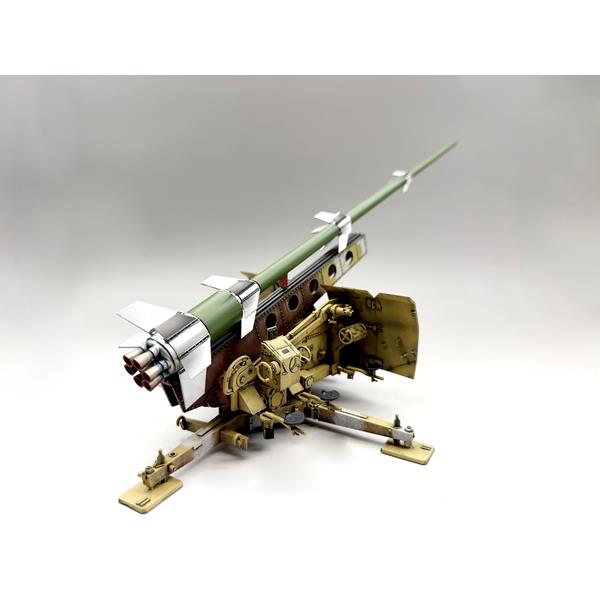
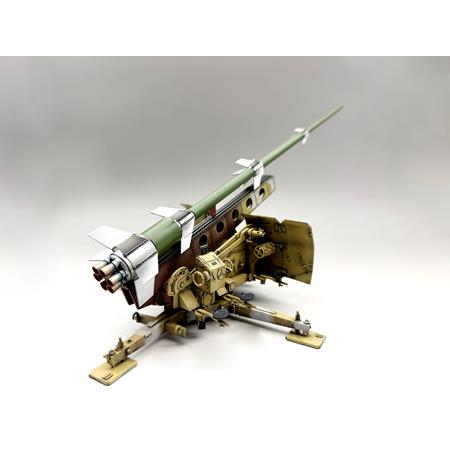
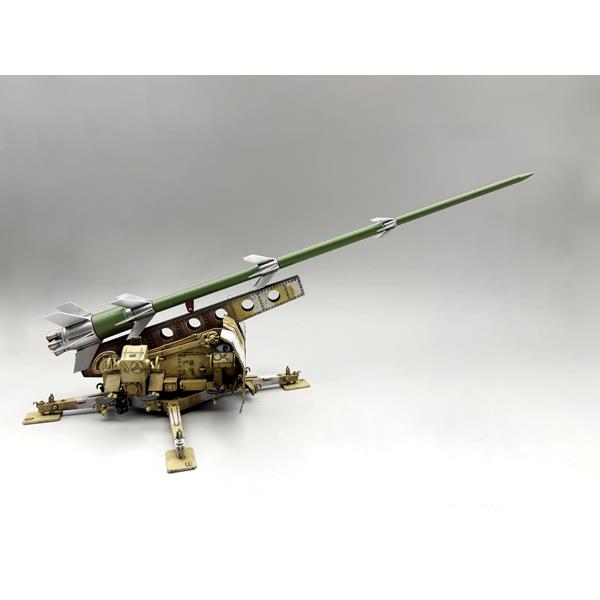
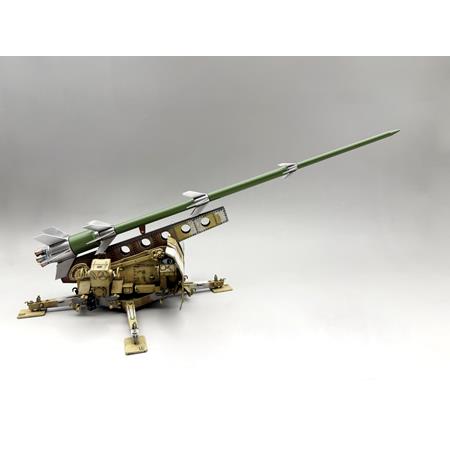


Rheinbote RH.Z.61/9 Rheinmetall long-range rocket
Item Number:
AH35A074
AH35A074
Manufacturer
AMUSING HOBBY
AMUSING HOBBY
Scale:
1:35
1:35

Please login here to see Prices.
Sonderangebot
Appears soon
We expect to arrive at early / middle of January 2027
Expected to appear early / middle of January 2027
Injection molding kit to build a Rheinbote long range rocket on gun carriage
Beginning in 1942, the German armament corporation Rheinmetall-Borsig developed a technologically fascinating yet militarily flawed weapon: the Rh.Z.61/9, better known as the "Rheinbote" (Rhine Messenger)—the world's first multi-stage, solid-fuel long-range rocket used in active combat. In contrast to the complex liquid-fueled V-2 rocket, this system relied on a four-stage solid-propellant drive powered by diglycol powder. With an impressive overall length of approximately 11.4 meters, a narrow fuselage diameter, and a remarkably slender silhouette, the rocket quickly earned the unofficial nickname "the flying pencil."
Weighing about 1,715 kilograms at launch, its four stages ignited sequentially, accelerating the rocket over a brief total burn time of just 25 seconds to extreme top speeds between Mach 4.8 and 5.5 (approx. 5,900 to 6,600 km/h). Through this sequential drive system, the Rheinbote achieved a ballistic range of 160 to 220 kilometers, climbing to peak trajectory altitudes of 78 kilometers or higher at maximum distance.
Despite these impressive engineering milestones, the weapon system proved to be a tactical failure in the final stage of World War II. The vast effort required to launch the rocket stood in stark contrast to its minimal payload: the warhead at the tip weighed a mere 40 kilograms and contained only about 25 kilograms of Amatol explosive—no more than a standard medium-caliber artillery shell. Because the unguided rocket lacked any active control mechanism after launch, it suffered from a massive circular error probable (CEP) of several kilometers. During deployments against the strategically vital port of Antwerp between late 1944 and early 1945, the rockets impacted at such high speeds that they buried themselves deep into the soil before detonating, causing their small explosive charges to fizzle out under the ground with virtually no effect. Consequently, while the Rheinbote stands as a pioneering forerunner to modern multi-stage solid-fuel rocketry, historically it squandered valuable resources for a negligible military impact.
- 1:35 scale
- not built/not painted
- Paint and glue not included
Beginning in 1942, the German armament corporation Rheinmetall-Borsig developed a technologically fascinating yet militarily flawed weapon: the Rh.Z.61/9, better known as the "Rheinbote" (Rhine Messenger)—the world's first multi-stage, solid-fuel long-range rocket used in active combat. In contrast to the complex liquid-fueled V-2 rocket, this system relied on a four-stage solid-propellant drive powered by diglycol powder. With an impressive overall length of approximately 11.4 meters, a narrow fuselage diameter, and a remarkably slender silhouette, the rocket quickly earned the unofficial nickname "the flying pencil."
Weighing about 1,715 kilograms at launch, its four stages ignited sequentially, accelerating the rocket over a brief total burn time of just 25 seconds to extreme top speeds between Mach 4.8 and 5.5 (approx. 5,900 to 6,600 km/h). Through this sequential drive system, the Rheinbote achieved a ballistic range of 160 to 220 kilometers, climbing to peak trajectory altitudes of 78 kilometers or higher at maximum distance.
Despite these impressive engineering milestones, the weapon system proved to be a tactical failure in the final stage of World War II. The vast effort required to launch the rocket stood in stark contrast to its minimal payload: the warhead at the tip weighed a mere 40 kilograms and contained only about 25 kilograms of Amatol explosive—no more than a standard medium-caliber artillery shell. Because the unguided rocket lacked any active control mechanism after launch, it suffered from a massive circular error probable (CEP) of several kilometers. During deployments against the strategically vital port of Antwerp between late 1944 and early 1945, the rockets impacted at such high speeds that they buried themselves deep into the soil before detonating, causing their small explosive charges to fizzle out under the ground with virtually no effect. Consequently, while the Rheinbote stands as a pioneering forerunner to modern multi-stage solid-fuel rocketry, historically it squandered valuable resources for a negligible military impact.
Customer Reviews 0
Schreiben Sie jetzt Ihre persönliche Erfahrung mit diesem Artikel und helfen Sie anderen bei deren Kaufentscheidung