
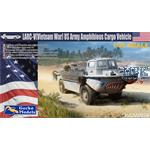
LARC-V (Vietnam War)
Item Number:
35GM0038
35GM0038
Manufacturer
Gecko Models
Gecko Models
Scale:
1:35
1:35
Please login here to see Prices.
More than 5 Pieces available
Shipping 1 - 4 days
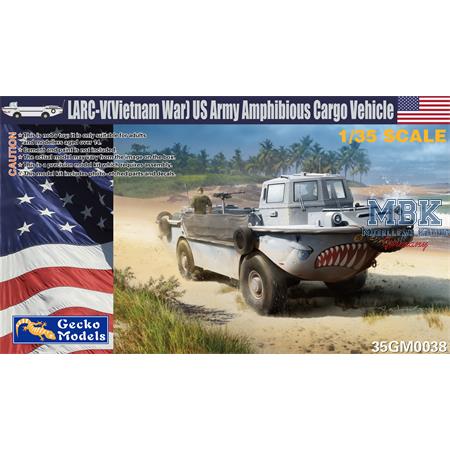
Plastic model kit of an early-version LARC-V amphibious transport vehicle.
The vehicle, measuring approximately 8.9 meters in length, was powered by a 300-hp Cummins V8 diesel engine that drove both the land and water propulsion systems. Permanent 4×4 drive enabled speeds of around 48 km/h on land and approximately 15 km/h in the water. It featured a fully watertight aluminum hull and a large, open cargo deck capable of carrying up to 5 tons of freight or about 20 soldiers.
Large numbers of LARC-Vs were deployed to South Vietnam starting in 1965. Initial units operated at the ports of Qui Nhơn, Cam Ranh Bay, and later Đà Nẵng. There, they handled "over-the-beach" resupply operations: they drove directly to anchored cargo ships to take on ammunition, vehicles, fuel, or supplies, transporting them straight to the beach or makeshift unloading points without the need for transshipment. This allowed for the landing of vast quantities of material even in locations lacking dock facilities.
LARC-V operations in Đà Nẵng became particularly well-known; there, the vehicles worked around the clock transporting bombs and ammunition from cargo ships to U.S. Air Force airfields. Supply operations were so critical that, in the event of breakdowns, spare parts were sometimes flown in from the USA to ensure uninterrupted service. In addition to supporting the Air Force, LARC-Vs assisted units such as the 101st Airborne Division and the 1st Cavalry Division in supplying their forward positions.
Although the LARC-V was not a combat vehicle, it frequently operated in hazardous coastal and riverine areas. The vehicles lacked armor and were equipped only with light machine guns for self-defense. However, their vital role in American logistics made them indispensable workhorses throughout the war. During the American withdrawal from Vietnam, around 500 LARC-Vs were scuttled or abandoned for economic reasons, while only a portion returned to the USA.
For modelers, the LARC-V offers numerous interesting possibilities for depiction in a Vietnam War context. Typical examples feature an Olive Drab finish with distinct signs of wear caused by saltwater, mud, and the tropical climate. Cargo decks were often loaded with ammunition pallets, barrels, supply crates, vehicle spare parts, or sandbags. Dioramas frequently show the LARC-V unloading a cargo ship, coming ashore on a sandy beach, operating at major logistics bases like Cam Ranh Bay or Da Nang, or transitioning from water to unpaved coastal roads—precisely the capability that made this extraordinary amphibious vehicle one of the most important logistics assets of the Vietnam War.
- 1:35 scale
- Includes clear parts and photo-etched parts
- Features detailed driver's cabin interior
- Flattened tires
- Includes fenders
- Includes .50 cal machine gun on a swivel mount
- 5 marking options:
- LARC V-830: US Army vehicle, Da Nang, Vietnam 1965
- LARC V-894: US Army vehicle, Da Nang, Vietnam 1965
- LARC V-850: US Army vehicle, Da Nang, Vietnam 1965
- LARC V-56: US Army vehicle, Da Nang, Vietnam 1965
- 14: Argentine Marines Vehicle, Falklands, April 2, 1982
- Unassembled, unpainted
- Paint and glue not included
The vehicle, measuring approximately 8.9 meters in length, was powered by a 300-hp Cummins V8 diesel engine that drove both the land and water propulsion systems. Permanent 4×4 drive enabled speeds of around 48 km/h on land and approximately 15 km/h in the water. It featured a fully watertight aluminum hull and a large, open cargo deck capable of carrying up to 5 tons of freight or about 20 soldiers.
Large numbers of LARC-Vs were deployed to South Vietnam starting in 1965. Initial units operated at the ports of Qui Nhơn, Cam Ranh Bay, and later Đà Nẵng. There, they handled "over-the-beach" resupply operations: they drove directly to anchored cargo ships to take on ammunition, vehicles, fuel, or supplies, transporting them straight to the beach or makeshift unloading points without the need for transshipment. This allowed for the landing of vast quantities of material even in locations lacking dock facilities.
LARC-V operations in Đà Nẵng became particularly well-known; there, the vehicles worked around the clock transporting bombs and ammunition from cargo ships to U.S. Air Force airfields. Supply operations were so critical that, in the event of breakdowns, spare parts were sometimes flown in from the USA to ensure uninterrupted service. In addition to supporting the Air Force, LARC-Vs assisted units such as the 101st Airborne Division and the 1st Cavalry Division in supplying their forward positions.
Although the LARC-V was not a combat vehicle, it frequently operated in hazardous coastal and riverine areas. The vehicles lacked armor and were equipped only with light machine guns for self-defense. However, their vital role in American logistics made them indispensable workhorses throughout the war. During the American withdrawal from Vietnam, around 500 LARC-Vs were scuttled or abandoned for economic reasons, while only a portion returned to the USA.
For modelers, the LARC-V offers numerous interesting possibilities for depiction in a Vietnam War context. Typical examples feature an Olive Drab finish with distinct signs of wear caused by saltwater, mud, and the tropical climate. Cargo decks were often loaded with ammunition pallets, barrels, supply crates, vehicle spare parts, or sandbags. Dioramas frequently show the LARC-V unloading a cargo ship, coming ashore on a sandy beach, operating at major logistics bases like Cam Ranh Bay or Da Nang, or transitioning from water to unpaved coastal roads—precisely the capability that made this extraordinary amphibious vehicle one of the most important logistics assets of the Vietnam War.
Customer Reviews 0
Schreiben Sie jetzt Ihre persönliche Erfahrung mit diesem Artikel und helfen Sie anderen bei deren Kaufentscheidung