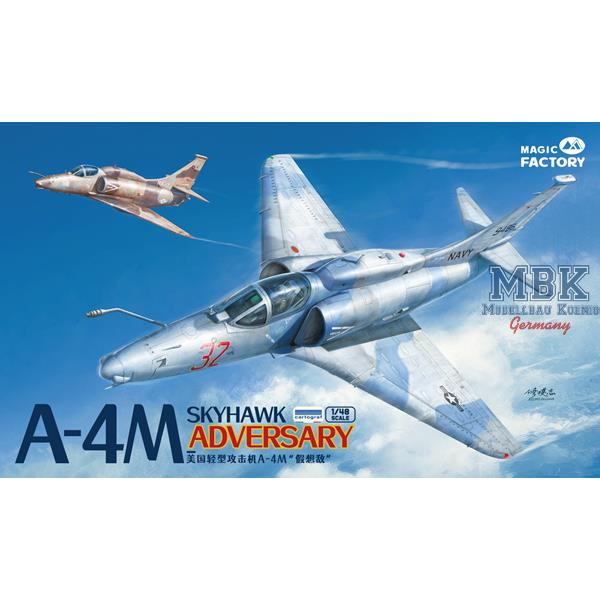
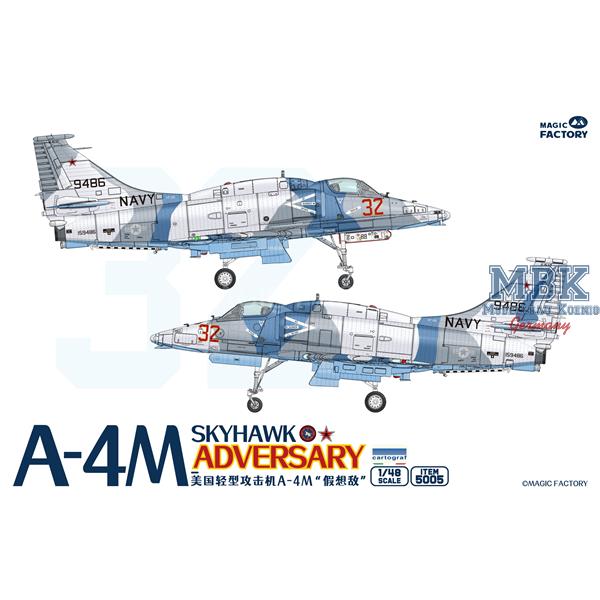
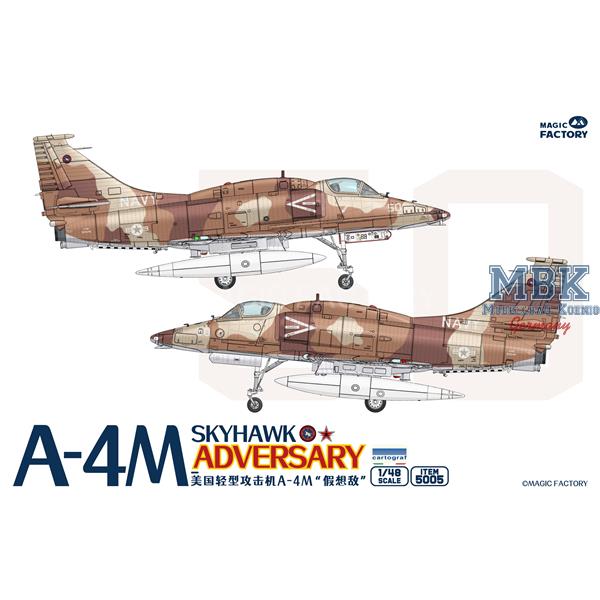
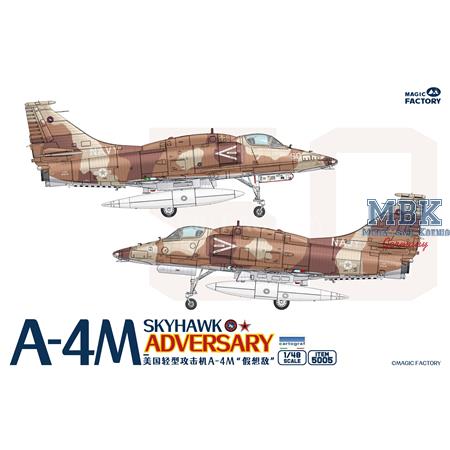


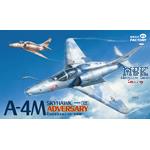
Douglas A-4M Skyhawk "Adversary"
Item Number:
MGF5005
MGF5005
Manufacturer
Magic Factory
Magic Factory
Scale:
1:48
1:48
Please login here to see Prices.
4 Pieces available
Shipping 1 - 4 days
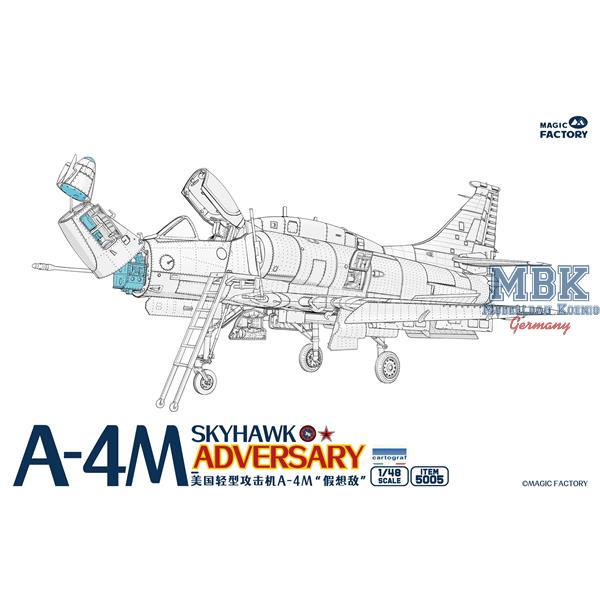
The Douglas A-4 Skyhawk was developed in the 1950s and was one of the most famous and popular light attack aircraft in aviation history.
Thanks to its compact size, it was extremely maneuverable and ideal for carrier operations.
It featured a simple design with characteristic low delta wings and small side air intakes, and was highly functional for operational use.
Powered by the Pratt & Whitney J52 turbojet engine, the Skyhawk could reach speeds of 1,170 km/h (700 mph).
Armed with two 20 mm (8") cannons, it could carry a deadly attack load consisting of air-to-air missiles, air-to-ground missiles, and free-fall bombs.
Due to its capabilities, the A-4 was a considerable commercial success.
The history of the A-4 Skyhawk as an "aggressor" or "adversary" began with the founding of the U.S. Navy Fighter Weapons School, better known as TOPGUN, in 1969.
The school's mission was to teach naval aviators how to outmaneuver and defeat enemy fighter aircraft in a new era of aerial combat. To do this, they needed an aircraft capable of simulating the flight characteristics of potential adversaries, particularly the agile Soviet MiG-17.
The A-4 Skyhawk, with its tight turning circle and small size, proved to be an ideal substitute.
The A-4 and other Skyhawk variants became a staple of various Navy and Marine Corps adversary squadrons. Squadrons such as VF-43, VF-45, VF-126, and VF-127 used the Skyhawk for realistic combat training.
These units employed a variety of striking camouflage schemes, often mimicking the paint schemes of potential enemy aircraft, to further intensify the training.
As an adversary, the A-4 posed a real challenge to the pilots of the Crusader and Phantom in aerial combat. Thanks to its air combat capabilities, the A-4 provided most fighter pilots with the necessary experience to prepare for real-world situations. The A-4 remained the ideal aircraft for simulating "bandits," even against the US Navy's newest fighter, the F-14 Tomcat. In a DACT (Dissimilar Air Combat Training) exercise against the powerful Tomcat, the A-4 was perfectly suited to play the role of a small, highly maneuverable fighter—difficult to detect and easy to lose sight of in combat. In 1987, some A-4Ms were stripped of all armor, non-essential avionics, and other equipment, reducing their empty weight by approximately 680 kilograms. These aircraft were deployed as needed to provide adversary combat training (DACT) to combat pilots from the U.S. Navy, Marine Corps, U.S. Air Force, and Canadian Armed Forces at various bases in the U.S. and Canada.
The A-4M served as an adversary aircraft well into the 1990s.
The last U.S. Navy Skyhawks, including the two-seat TA-4J models, were officially retired in 2003. However, the A-4 Skyhawk's legacy as an adversary air combat platform lives on. Its enduring maneuverability and low operating costs make it a popular choice for private defense contractors providing adversary air support to armed forces. These modern adversary Skyhawks, some equipped with advanced systems such as active electronically scanned array (AESA) radar, continue to challenge and train a new generation of pilots, ensuring that the "little jet that made it" remains an important part of air combat training worldwide.
The last U.S. Navy Skyhawks, including the two-seat TA-4J models, were officially retired in 2003.
Plastic model kit
unbuilt / unpainted
Paint and glue not included
Thanks to its compact size, it was extremely maneuverable and ideal for carrier operations.
It featured a simple design with characteristic low delta wings and small side air intakes, and was highly functional for operational use.
Powered by the Pratt & Whitney J52 turbojet engine, the Skyhawk could reach speeds of 1,170 km/h (700 mph).
Armed with two 20 mm (8") cannons, it could carry a deadly attack load consisting of air-to-air missiles, air-to-ground missiles, and free-fall bombs.
Due to its capabilities, the A-4 was a considerable commercial success.
The history of the A-4 Skyhawk as an "aggressor" or "adversary" began with the founding of the U.S. Navy Fighter Weapons School, better known as TOPGUN, in 1969.
The school's mission was to teach naval aviators how to outmaneuver and defeat enemy fighter aircraft in a new era of aerial combat. To do this, they needed an aircraft capable of simulating the flight characteristics of potential adversaries, particularly the agile Soviet MiG-17.
The A-4 Skyhawk, with its tight turning circle and small size, proved to be an ideal substitute.
The A-4 and other Skyhawk variants became a staple of various Navy and Marine Corps adversary squadrons. Squadrons such as VF-43, VF-45, VF-126, and VF-127 used the Skyhawk for realistic combat training.
These units employed a variety of striking camouflage schemes, often mimicking the paint schemes of potential enemy aircraft, to further intensify the training.
As an adversary, the A-4 posed a real challenge to the pilots of the Crusader and Phantom in aerial combat. Thanks to its air combat capabilities, the A-4 provided most fighter pilots with the necessary experience to prepare for real-world situations. The A-4 remained the ideal aircraft for simulating "bandits," even against the US Navy's newest fighter, the F-14 Tomcat. In a DACT (Dissimilar Air Combat Training) exercise against the powerful Tomcat, the A-4 was perfectly suited to play the role of a small, highly maneuverable fighter—difficult to detect and easy to lose sight of in combat. In 1987, some A-4Ms were stripped of all armor, non-essential avionics, and other equipment, reducing their empty weight by approximately 680 kilograms. These aircraft were deployed as needed to provide adversary combat training (DACT) to combat pilots from the U.S. Navy, Marine Corps, U.S. Air Force, and Canadian Armed Forces at various bases in the U.S. and Canada.
The A-4M served as an adversary aircraft well into the 1990s.
The last U.S. Navy Skyhawks, including the two-seat TA-4J models, were officially retired in 2003. However, the A-4 Skyhawk's legacy as an adversary air combat platform lives on. Its enduring maneuverability and low operating costs make it a popular choice for private defense contractors providing adversary air support to armed forces. These modern adversary Skyhawks, some equipped with advanced systems such as active electronically scanned array (AESA) radar, continue to challenge and train a new generation of pilots, ensuring that the "little jet that made it" remains an important part of air combat training worldwide.
The last U.S. Navy Skyhawks, including the two-seat TA-4J models, were officially retired in 2003.
Plastic model kit
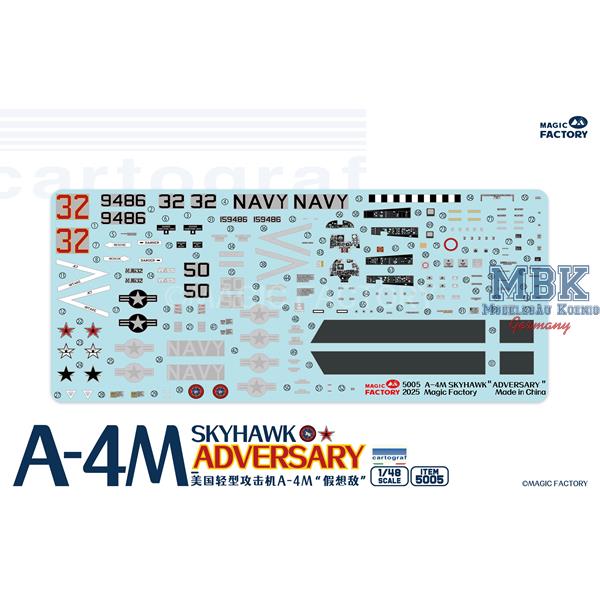
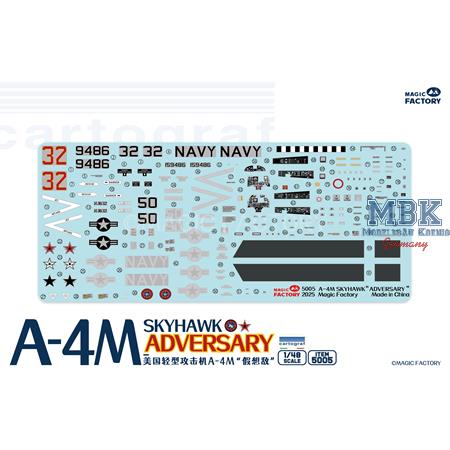
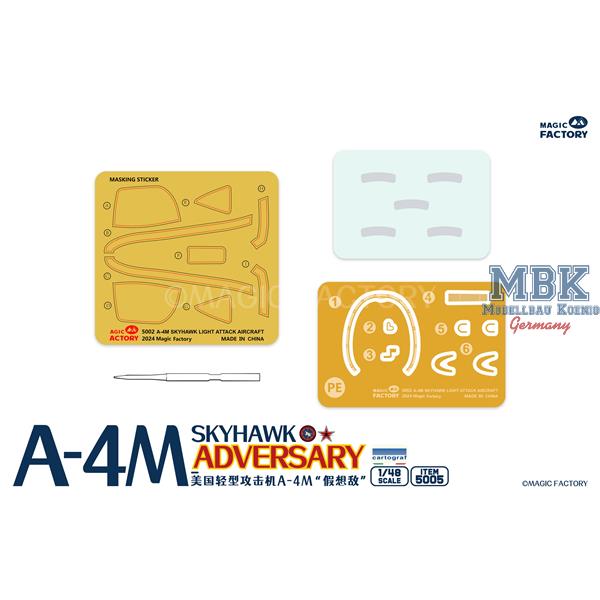
- Two decal options
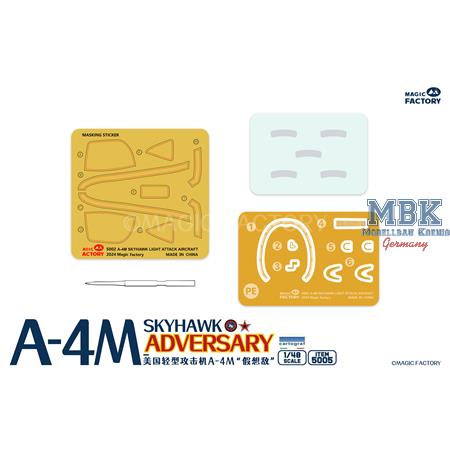
- Photo-etched parts
- Masks
- Pitot tube
unbuilt / unpainted
Paint and glue not included
Customer Reviews 0
Schreiben Sie jetzt Ihre persönliche Erfahrung mit diesem Artikel und helfen Sie anderen bei deren Kaufentscheidung