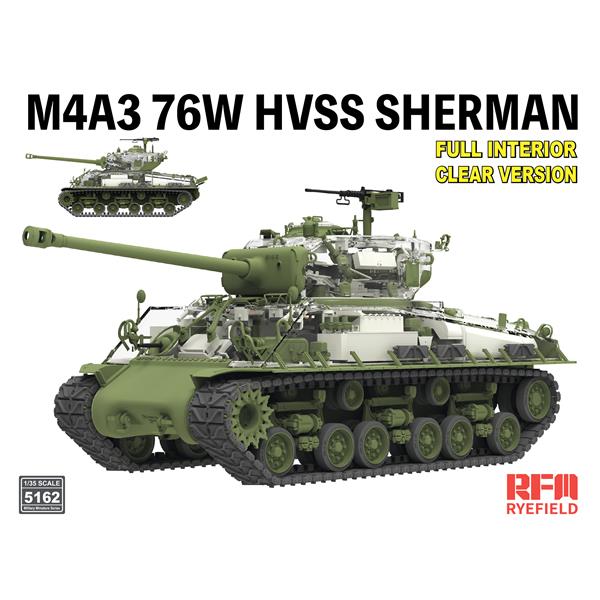
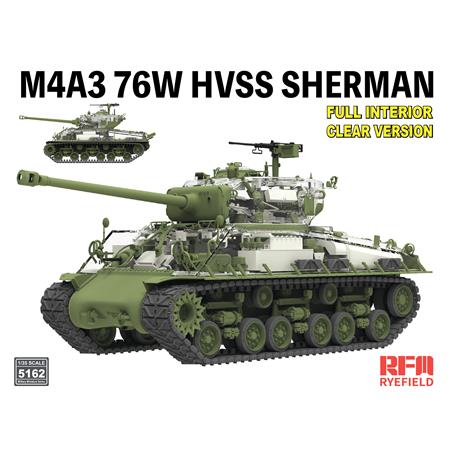
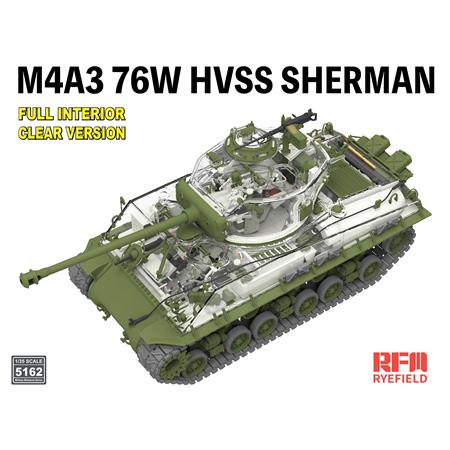
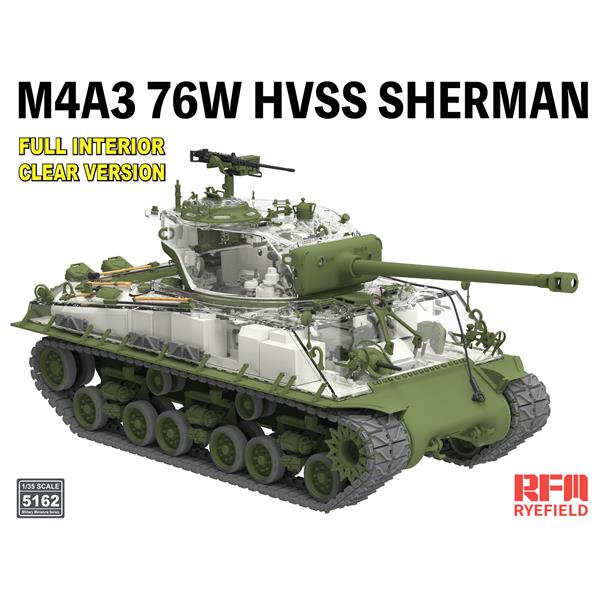
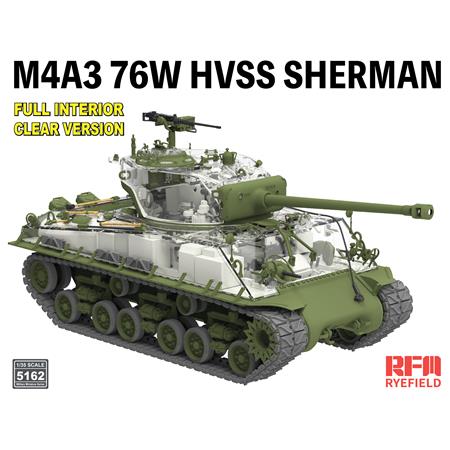
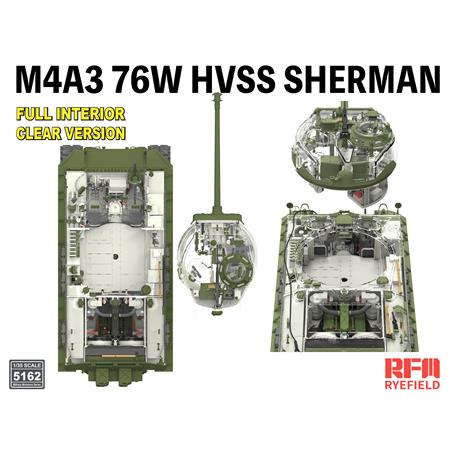


M4A3 76W HVSS Sherman late full interior CLEAR VS.
RFM5162
RYE FIELD MODEL
1:35
Plastic model kit for a late M4A3 76W HVSS Sherman
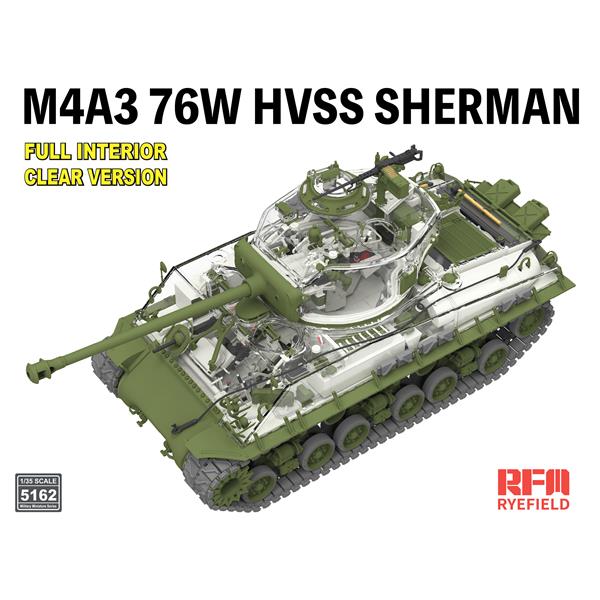
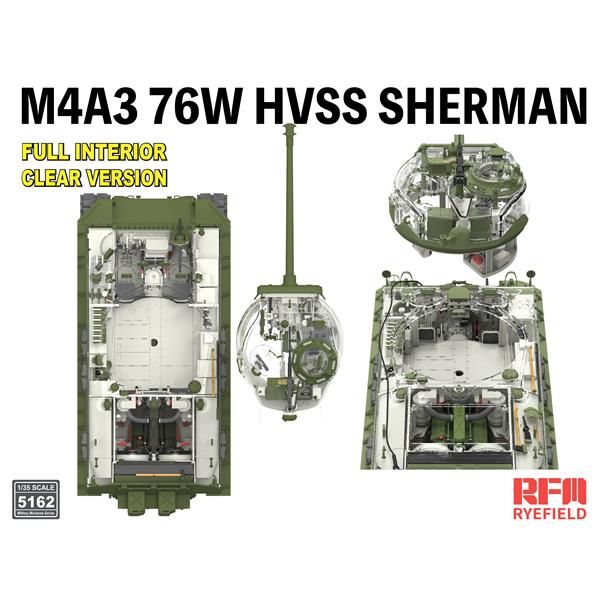
CLEAR EDITION - complete interior detail
- Scale 1:35
- Clear parts for turret and hull
- Complete interior detail (engine compartment, driver's compartment, fighting compartment, and turret)
- Clear and photo-etched parts included
- Workable individual track links and running gear
- Hatches can be built open or closed
- Unbuilt, unpainted
- Paint and glue not included
The late M4A3(76)W HVSS Sherman was considered the most powerful production version of the famous American Sherman tank of World War II. Appearing from late 1944 onward, this variant combined nearly all the major improvements of the Sherman development: the powerful Ford GAA V8 engine, the 76 mm M1A2 gun, the safe "wet stowage" ammunition storage system, and the new HVSS ("Horizontal Volute Spring Suspension") running gear. Because of its experimental designation M4A3E8, the tank earned the well-known nickname "Easy Eight."
Technically, the late HVSS Sherman differed significantly from earlier Sherman versions. The new suspension featured wider tracks and horizontally arranged leaf springs, which considerably improved ride comfort, reliability, and off-road capability. Especially in the muddy terrain of Western Europe, the tank exhibited significantly better maneuverability than older VVSS Shermans with narrower tracks. The 76 mm gun was more effective against German tanks like the Panther and Panzer IV, although it still struggled against the frontal armor of heavy German vehicles. Characteristic features of later models included the wide HVSS suspension, the T23 turret with muzzle brake, and the large driver's and radio operator's hatches of the so-called "Large Hatch" hull.
These vehicles were characterized by their ... wider tracks and horizontally arranged leaf springs, which significantly improved ride comfort, reliability, and off-road capability. The M4A3(76)W HVSS saw action in Europe and the Pacific during the final months of the war in 1944/45, proving itself particularly reliable due to its high mechanical performance and good mobility. After the war, it remained in service in large numbers and was used in the Korean War, among other campaigns. Many countries continued to use modernized "Easy Eight" Shermans well into the 1960s and, in some cases, the 1970s.
Schreiben Sie jetzt Ihre persönliche Erfahrung mit diesem Artikel und helfen Sie anderen bei deren Kaufentscheidung